

Clinique TAGMED Montreal / Mont-Royal
Herniated Disc Treatment in Montreal
Disc-focused, non-surgical care for selected patients with persistent back pain, sciatica, leg pain, numbness, or tingling.
If you live in Montreal, Mont-Royal, Outremont, Côte-des-Neiges, Laval, Saint-Laurent, Ahuntsic, Villeray, Rosemont, NDG, Westmount, Longueuil, Brossard, or nearby areas, and your herniated disc symptoms have not improved with previous care, a disc-focused evaluation may help determine whether a decompression-first approach is appropriate.

A local option for persistent disc symptoms
When a herniated disc keeps irritating the nerve, generic back-pain advice may not be enough.
A herniated disc is not simply a weak back or a tight muscle. It can involve pressure inside the disc, irritation around a nerve root, inflammation, protective muscle guarding, and reduced tolerance to sitting, bending, lifting, stretching, or exercise.
At Clinique TAGMED Montreal / Mont-Royal, Dr. Sylvain Desforges evaluates selected patients with suspected or confirmed herniated disc symptoms to determine whether a pressure-reduction strategy, including spinal decompression when appropriate, may be suitable.
The objective is not to promise a cure or force rapid movement. The objective is to understand the mechanical behavior of the disc and create a personalized plan that respects the stage of irritation, tissue tolerance, and symptom response.
Understanding the condition
What Is a Herniated Disc?
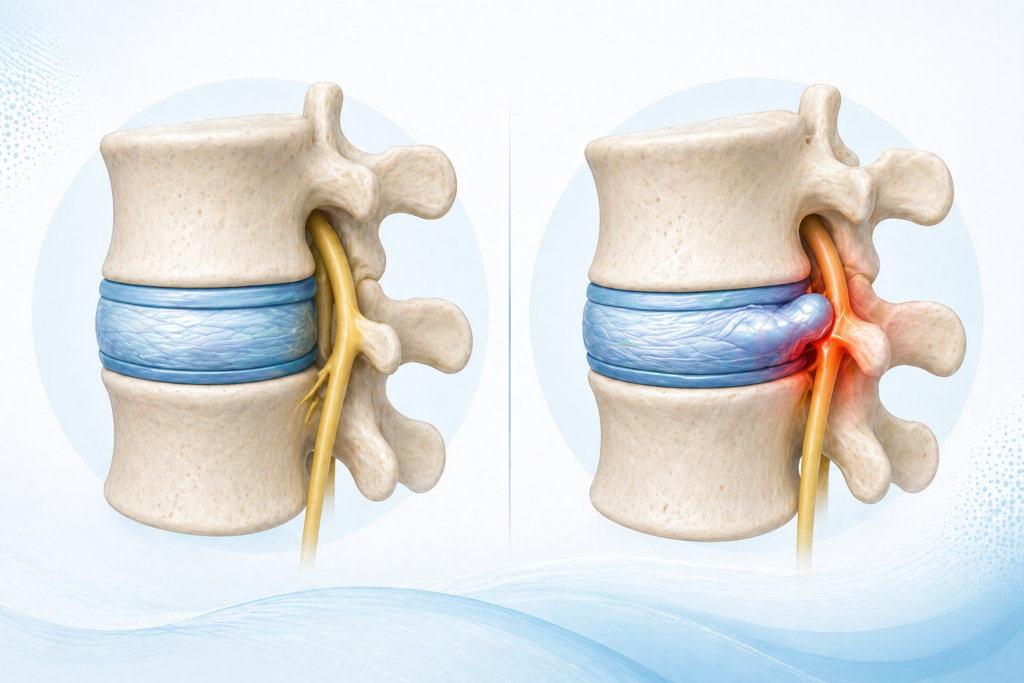
A herniated disc occurs when the inner disc material moves through or toward a weakened area of the outer disc wall.
The disc is pressure-sensitive
The spinal disc works like a pressurized structure. When its outer wall is weakened, increased pressure may push disc material toward the irritated area.
The nerve may become irritated
When disc material approaches or irritates a nerve root, symptoms may travel into the buttock, thigh, calf, foot, shoulder, arm, or hand depending on the disc level.
Timing matters
Some movements may be useful later but provocative early. A disc that is inflamed or pressure-sensitive may first need unloading and calming.
Common symptom patterns
Symptoms That May Suggest a Herniated Disc
Symptoms vary depending on the location of the disc, the direction of irritation, and whether a nerve root is involved.
- Lower back pain with buttock or leg pain
- Sciatica traveling into the thigh, calf, or foot
- Neck pain with shoulder, arm, or hand symptoms
- Numbness, tingling, burning, or electric-like sensations
- Pain that worsens with sitting or driving
- Pain that flares after stretching or core exercises
- Back spasms or protective muscle guarding
- Symptoms that worsen several hours after activity
- Difficulty standing, walking, working, or sleeping comfortably
- Persistent symptoms after previous conservative care
Symptoms alone do not determine whether spinal decompression is appropriate. A disc-focused evaluation is needed to understand the mechanical behavior of your condition.
TAGMED clinical approach
Why a Decompression-First Strategy May Be Considered
Many patients with herniated disc symptoms have already tried stretching, strengthening, medication-based strategies, or general back-care advice. When symptoms persist, the missing piece may be mechanical pressure.
“Before a pressure-sensitive disc is progressively loaded, it may first need to be calmed, unloaded, and evaluated.”
1
Evaluate the disc pattern
We assess whether symptoms behave like a pressure-sensitive disc pattern, a nerve irritation pattern, or another mechanical presentation.
2
Reduce aggravating load
When appropriate, care may focus on reducing provocative compression, flexion, rotation, or prolonged sitting stress.
3
Support safe progression
Movement and strengthening may be reintroduced later, once the disc and nerve show better tolerance.
When symptoms keep returning
Why Some Herniated Disc Patients Do Not Improve with Generic Exercise Advice
The problem is not always effort. Sometimes patients are doing too much of the wrong mechanical stress at the wrong stage.
Stretching can mislead
Stretching may feel relieving during the movement but still irritate the sciatic nerve or disc afterward, creating delayed flare-ups.
Core bracing can compress
Core exercises stabilize by creating tension. In an active disc irritation, that tension may increase compression too early.
Sitting can maintain pressure
Prolonged sitting can keep lumbar disc pressure elevated, especially when the patient sits in a flexed or slumped posture.
Delayed symptoms matter
A movement is not automatically safe because it feels acceptable during the activity. The true test is how symptoms behave later.
Technology-based care when appropriate
TAGMED Services That May Be Considered
Depending on the evaluation, selected patients may be considered for one or more non-surgical, non-invasive TAGMED services.
Spinal decompression
Controlled unloading designed to reduce mechanical pressure on selected spinal segments.
Specific osteopathy
Precise biomechanical care adapted to the patient’s presentation and tolerance.
Class IV medical laser
May be used when clinically appropriate to support pain and inflammation management.
Precision percussion
Instrument-assisted treatment may be used selectively as part of a personalized plan.
Conditions commonly evaluated
Disc-Related Conditions We Commonly Evaluate in Montreal
Patients commonly seek care for disc-related symptom patterns that interfere with work, sitting, driving, walking, and sleep.
- Lumbar herniated disc
- L4-L5 herniated disc
- L5-S1 herniated disc
- Cervical herniated disc
- Disc protrusion
- Bulging disc
- Sciatica
- Radiating leg pain
- Numbness and tingling
- Disc-related low back pain
Local access
Serving Montreal and Nearby Communities
Because a decompression protocol may require repeated visits, this page is intended for patients who can realistically attend in-person care at the Montreal / Mont-Royal clinic.
Central Montreal
Mont-Royal, Outremont, Côte-des-Neiges, NDG, Westmount, Ville-Marie, Rosemont and nearby areas.
North and West Montreal
Saint-Laurent, Ahuntsic, Villeray, Laval, Dorval, Pointe-Claire, Kirkland and nearby communities.
South Shore access
Longueuil, Brossard, Saint-Lambert and selected nearby communities within realistic driving distance.
- Montreal
- Mont-Royal
- Outremont
- Côte-des-Neiges
- NDG
- Westmount
- Saint-Laurent
- Ahuntsic
- Villeray
- Rosemont
- Laval
- Longueuil
- Brossard
- West Island
What to expect
How a Disc-Focused Evaluation Works
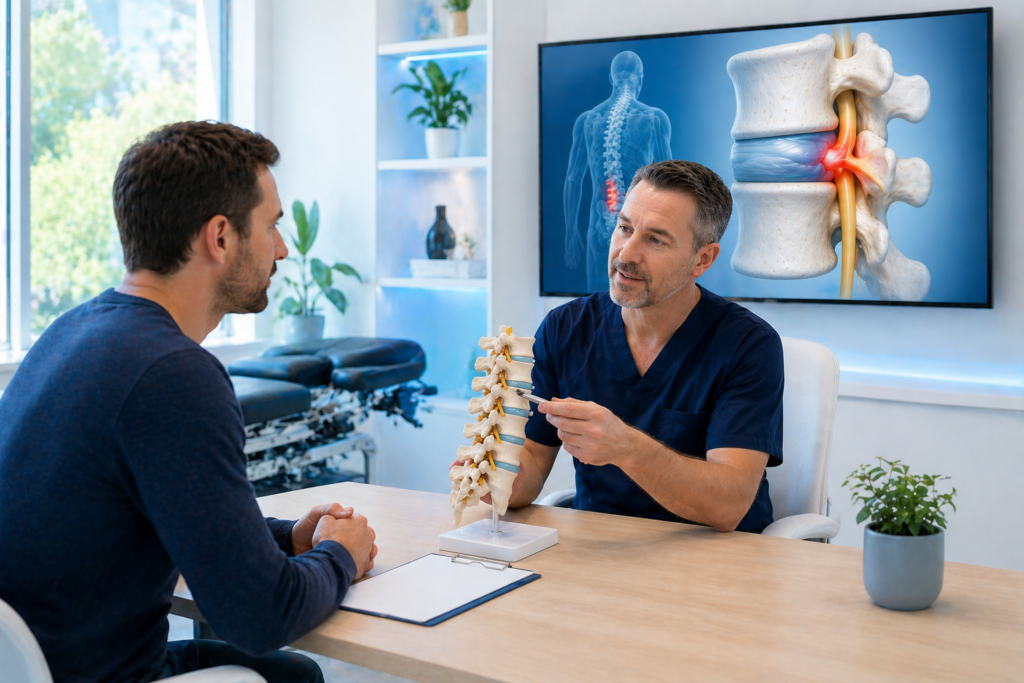
The evaluation is designed to determine whether your symptoms appear compatible with a decompression-based strategy and whether any safety concerns are present.
1
Symptom history
We review your pain pattern, previous care, daily limitations, and what makes symptoms better or worse.
2
Clinical assessment
We assess movement tolerance, nerve irritation signs, postural triggers, and mechanical sensitivity.
3
Imaging review
If you already have MRI or other imaging reports, bring them to your appointment for review.
4
Personalized plan
If appropriate, a decompression-focused plan may be recommended based on your presentation and tolerance.
Safety first
When Herniated Disc Symptoms Require Urgent Medical Attention
Most herniated disc cases are not emergencies, but some symptoms require immediate medical evaluation.
- Loss of bladder or bowel control
- Saddle numbness in the groin or inner thighs
- Rapidly worsening leg weakness
- Progressive foot drop
- Sudden severe weakness in both legs
- Fever with severe spinal pain
- Major trauma
- History of cancer with new severe spinal pain
Urgent care warning
If you experience bladder or bowel changes, saddle numbness, rapidly worsening weakness, or severe progressive neurological symptoms, seek urgent medical evaluation immediately.
Patient questions
Frequently Asked Questions About Herniated Disc Treatment in Montreal
Is herniated disc treatment available at the Montreal clinic?
Yes. Clinique TAGMED Montreal / Mont-Royal evaluates selected patients with herniated disc symptoms, sciatica, radiating pain, numbness, tingling, and pressure-sensitive spinal pain.
Can spinal decompression help a herniated disc?
Spinal decompression may be appropriate for selected patients with disc-related symptoms. A disc-focused evaluation is needed to determine whether your condition fits this type of mechanical approach.
What if exercises made my symptoms worse?
If stretching or strengthening repeatedly worsens your symptoms, the disc may still be mechanically reactive. A decompression-first evaluation may help determine whether loading was introduced too early.
Do I need an MRI before booking?
An MRI can be helpful, but it is not always required before the first evaluation. If you already have imaging reports, bring them to your appointment.
How often would I need to come for decompression care?
Spinal decompression protocols often require repeated visits over several weeks. This is why patients should live within realistic driving distance of the Montreal clinic.
Is this covered by RAMQ?
No. TAGMED services are private and are not covered by RAMQ. Receipts are issued for osteopathy and may be reimbursable by many private insurance plans, depending on your coverage.
Related resources