

Clinique TAGMED Terrebonne
Herniated Disc Treatment After Failed Injections in Terrebonne
Disc-focused, non-surgical care for selected North Shore patients whose herniated disc or sciatica symptoms returned after injection-based care.
If you live in Terrebonne, Mascouche, Repentigny, Laval, Blainville, Boisbriand, Sainte-Thérèse, Rosemère, Lorraine, Saint-Eustache, Saint-Jérôme, Charlemagne, L’Assomption, Anjou, Montréal-Nord, or nearby areas, and your herniated disc or sciatica symptoms returned after injection-based care, a disc-focused evaluation may help determine whether the underlying mechanical pressure remains active.
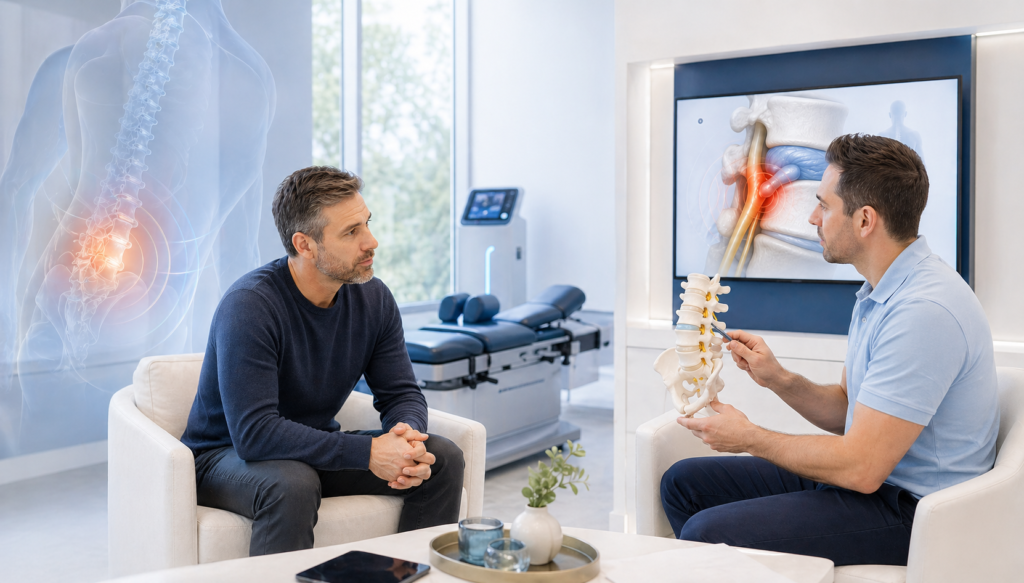
When pain relief did not last
If symptoms returned after injections, the disc may still be mechanically irritated.
Many patients seek injection-based care because they are trying to reduce inflammation and pain. Some patients may feel temporary relief. However, if the herniated disc remains pressure-sensitive, symptoms may return because the mechanical environment around the disc and nerve has not changed enough.
At Clinique TAGMED Terrebonne, Dr. Sylvain Desforges evaluates selected patients whose symptoms returned after previous care. The goal is to determine whether a pressure-reduction strategy, including spinal decompression when appropriate, may be suitable.
This page does not criticize injection-based care. It explains why inflammation control and mechanical pressure reduction are different goals. A disc may feel calmer for a period of time, yet still remain vulnerable to sitting, bending, lifting, stretching, bracing, or compression.
The missing mechanical factor
Why Pain Can Return After Injection-Based Care
Injection-based care may aim to reduce inflammation. But a herniated disc can also involve mechanical pressure, disc deformation, nerve irritation, and movement intolerance.
Inflammation may decrease temporarily
Some patients feel better for a period of time when inflammation is reduced, but the mechanical stress around the disc may remain.
Disc pressure may persist
If sitting, bending, lifting, or bracing continues to aggravate symptoms, the disc may still be mechanically reactive.
The nerve may remain sensitive
A nerve root that has been irritated for weeks or months may still react to pressure, stretch, compression, or repeated loading.
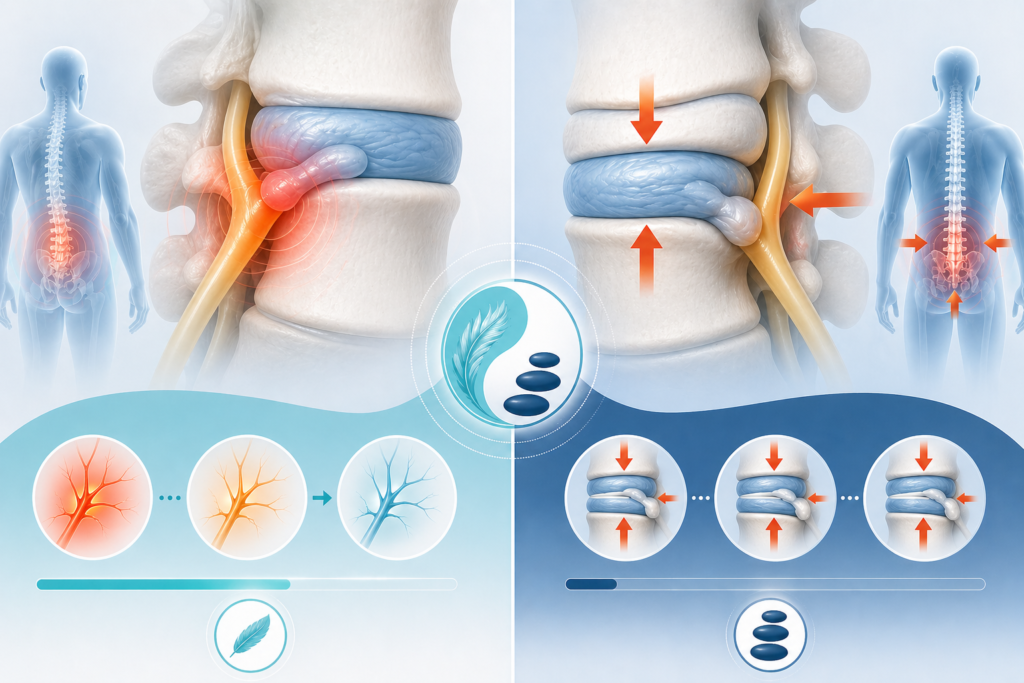
When symptoms return
Signs That the Disc May Still Be Mechanically Reactive
If symptoms returned after injections or pain relief was short-lived, the disc and nerve may still need a mechanical strategy.
- Sciatica returned after temporary relief
- Pain still worsens with sitting or driving
- Leg pain travels into the thigh, calf, ankle, or foot
- Numbness, tingling, burning, or electric-like sensations persist
- Symptoms flare after bending, lifting, or twisting
- Stretching still causes delayed irritation
- Core exercises or bracing increase symptoms
- Pain worsens later in the day or the next morning
- Back spasms or protective guarding remain frequent
- Daily activities still feel limited by disc-related pain
Returning symptoms do not mean that nothing can be done. They may indicate that the mechanical environment around the disc and nerve still needs to be evaluated.
Biomechanical explanation
Inflammation Control Is Not the Same as Disc Pressure Reduction
A herniated disc may involve both inflammation and mechanical stress. Reducing one does not always fully resolve the other.
Inflammation can drive pain
An irritated nerve root may produce burning, tingling, electric, or radiating symptoms when inflammation is active.
Pressure can keep irritation active
If the disc continues to load or bulge toward the nerve, mechanical irritation may keep symptoms recurring.
Movement may remain provocative
Sitting, bending, lifting, twisting, or aggressive stretching may continue to trigger the disc and nerve.
A new sequence may be needed
Selected patients may require decompression-first care before movement and strengthening are reconsidered.
TAGMED clinical approach
Our Strategy: Evaluate the Mechanical Cause of Persistent Symptoms
When injection-based care does not provide lasting improvement, the next question is whether disc pressure, nerve irritation, and movement intolerance remain active.
“Before a pressure-sensitive disc is progressively loaded, it may first need to be calmed, unloaded, and evaluated.”
1
Review symptom behavior
We review what improved, what returned, and which movements or positions still provoke symptoms.
2
Assess disc mechanics
We evaluate whether sitting, bending, stretching, bracing, or lifting suggests a pressure-sensitive disc pattern.
3
Consider decompression
When appropriate, spinal decompression may be considered to reduce mechanical stress around selected spinal segments.
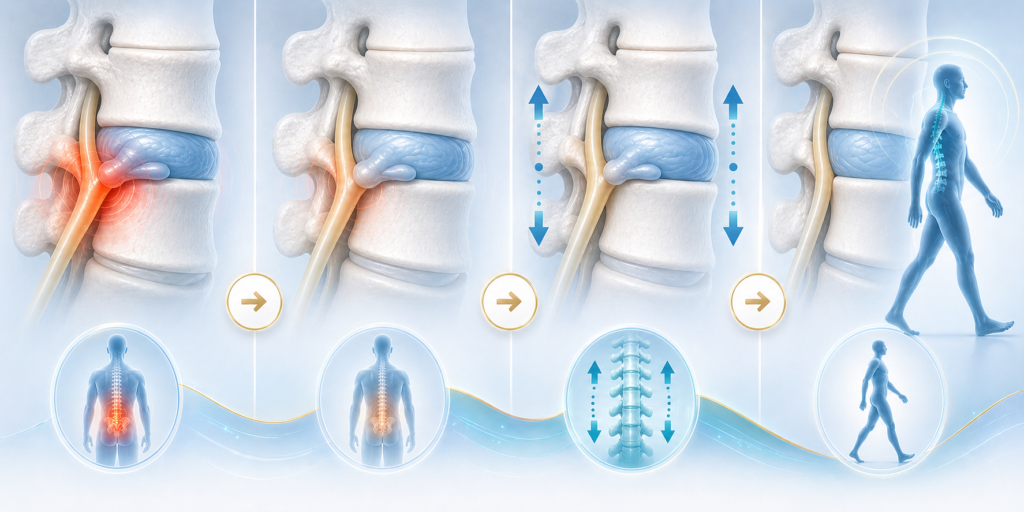
Pressure-reduction option
How Spinal Decompression May Fit After Failed Injections
Spinal decompression is designed to gently unload selected spinal segments using controlled traction. It may be considered when the evaluation suggests that disc pressure contributes to persistent or recurring symptoms.
Different goal from injections
Injection-based care may focus on inflammation. Decompression focuses on reducing mechanical pressure in selected cases.
Disc and nerve environment
In selected patients, reducing pressure may help create a less provocative environment around the irritated disc and nerve root.
Stepwise progression
Decompression may be part of a plan that later includes safer movement and stabilization when symptoms are less reactive.
Conditions commonly evaluated
Disc-Related Conditions We Commonly Evaluate After Failed Injections
Patients commonly seek a disc-focused evaluation when symptoms return after previous care and continue to interfere with sitting, driving, walking, work, and sleep.
- Lumbar herniated disc
- L4-L5 herniated disc
- L5-S1 herniated disc
- Disc protrusion
- Bulging disc
- Sciatica
- Radiating leg pain
- Numbness and tingling
- Disc-related low back pain
- Persistent symptoms after injection-based care
What to expect
How the Evaluation Works
The evaluation helps determine why symptoms may have returned and whether a decompression-based strategy may be appropriate.
1
Review prior response
We review whether relief was temporary, incomplete, or followed by recurring symptoms.
2
Map symptoms
We evaluate where symptoms travel and whether leg pain, numbness, tingling, or weakness is present.
3
Assess triggers
We assess whether sitting, bending, stretching, driving, or loading still provokes symptoms.
4
Plan next steps
If appropriate, a decompression-focused plan may be recommended based on your presentation.
Local access
Serving Terrebonne and Nearby North Shore Communities
Because decompression care may require repeated visits, this page is intended for patients who can realistically attend in-person care at the Terrebonne clinic.
- Terrebonne
- Mascouche
- Repentigny
- Laval
- Blainville
- Boisbriand
- Sainte-Thérèse
- Rosemère
- Lorraine
- Saint-Eustache
- Saint-Jérôme
- Anjou
- Montréal-Nord
- Rivière-des-Prairies
Safety first
When Herniated Disc Symptoms Require Urgent Medical Attention
Most herniated disc cases are not emergencies, but some symptoms require immediate medical evaluation.
- Loss of bladder or bowel control
- Saddle numbness in the groin or inner thighs
- Rapidly worsening leg weakness
- Progressive foot drop
- Sudden severe weakness in both legs
- Fever with severe spinal pain
- Major trauma
- History of cancer with new severe spinal pain
Urgent care warning
If you experience bladder or bowel changes, saddle numbness, rapidly worsening weakness, or severe progressive neurological symptoms, seek urgent medical evaluation immediately.
Patient questions
Frequently Asked Questions About Herniated Disc Care After Failed Injections
Why did my pain return after injections?
Pain may return if inflammation was reduced temporarily but the underlying mechanical stress around the disc and nerve remained active.
Can spinal decompression help after failed injections?
Spinal decompression may be appropriate for selected patients when symptoms suggest persistent disc pressure or nerve irritation. A disc-focused evaluation is needed first.
Is decompression the same goal as injections?
No. Injection-based care may focus on inflammation. Spinal decompression focuses on reducing mechanical pressure around selected spinal segments when appropriate.
What if my sciatica improved briefly but returned?
Temporary relief followed by recurrence may suggest that the nerve became less inflamed for a time, but the disc and mechanical triggers still need evaluation.
Do I need an MRI before booking?
An MRI can be helpful, but it is not always required before the first evaluation. If you already have imaging reports, bring them to your appointment.
Is this covered by RAMQ?
No. TAGMED services are private and are not covered by RAMQ. Receipts are issued for osteopathy and may be reimbursable by many private insurance plans, depending on your coverage.
Related resources