

Clinique TAGMED Montreal / Mont-Royal
Sciatica Treatment in Montreal
Disc-focused, non-surgical care for selected patients with sciatic pain, radiating leg symptoms, numbness, tingling, or herniated disc irritation.
If you live in Montreal, Mont-Royal, Outremont, Côte-des-Neiges, Laval, Saint-Laurent, Ahuntsic, Villeray, Rosemont, NDG, Westmount, Longueuil, Brossard, or nearby areas, and your sciatica has not improved with previous care, a disc-focused evaluation may help determine whether your pain is related to a pressure-sensitive herniated disc.
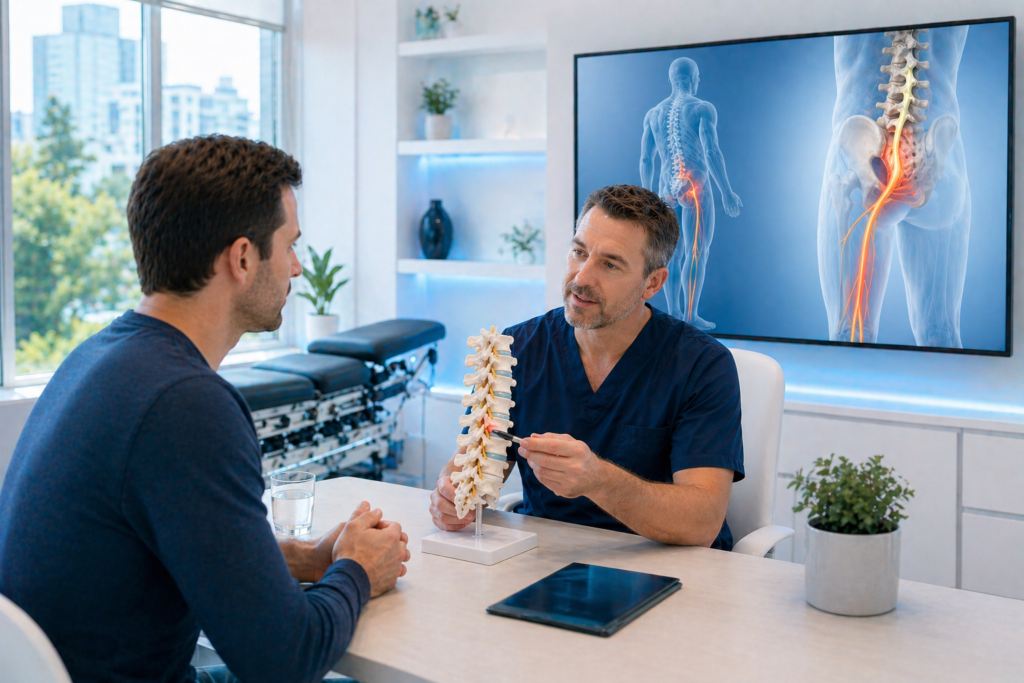
Understanding sciatic pain
Sciatica is not always a muscle problem.
Many patients describe sciatica as a sharp, burning, electric, or shooting pain that travels from the lower back or buttock into the thigh, calf, or foot. Some also experience numbness, tingling, weakness, or pain that worsens when sitting, driving, bending, or stretching.
While sciatic pain can have different causes, one common pattern involves irritation of a nerve root near a lumbar herniated disc. In that situation, generic stretching or strengthening may not address the main problem if the disc remains pressure-sensitive.
At Clinique TAGMED Montreal / Mont-Royal, Dr. Sylvain Desforges evaluates selected patients with persistent sciatica to determine whether a disc-focused, decompression-first strategy may be appropriate.
The nerve component
What Is Sciatica?
Sciatica refers to pain or neurological symptoms that travel along the sciatic nerve pathway, often from the lower back or buttock into the leg.
It may involve nerve irritation
Sciatica often reflects irritation of one or more nerve roots that contribute to the sciatic nerve.
It may be disc-related
A lumbar herniated disc can irritate or compress a nearby nerve root, causing symptoms to travel down the leg.
It may react later
Sciatica does not always worsen during activity. It may flare several hours later once the irritated nerve reacts.
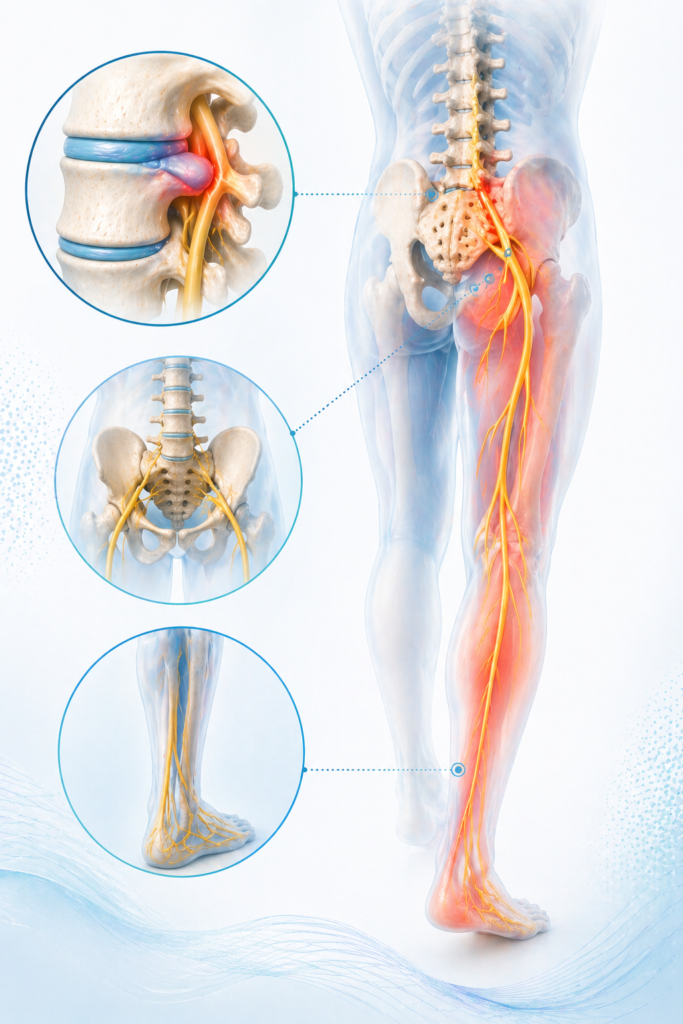
Symptoms patients often report
Common Sciatica Symptoms
Sciatica can appear in different ways depending on the irritated nerve root, posture sensitivity, and disc mechanics.
- Pain traveling from the lower back into the buttock
- Pain radiating into the thigh, calf, ankle, or foot
- Burning, electric, shooting, or stabbing leg pain
- Numbness or tingling in the leg or foot
- Pain that worsens with sitting or driving
- Pain that increases after bending or lifting
- Sciatica that flares after stretching
- Symptoms that worsen after core exercises
- Back spasms or protective muscle guarding
- Symptoms that are worse later in the day or the next morning
If sciatic pain travels farther down the leg, increases after exercise, or is associated with weakness, it should be evaluated carefully.
TAGMED clinical approach
Our Strategy: Calm the Nerve Before Loading the Spine
When sciatica is active, the nervous system may be hypersensitive. The goal is not to push through pain. The goal is to understand what mechanical forces are keeping the nerve irritated.
“Before an irritated sciatic nerve is challenged with stretching or strengthening, it may first need less pressure, less tension, and a calmer mechanical environment.”
1
Identify triggers
We evaluate whether sitting, bending, stretching, lifting, or exercise is reproducing sciatic symptoms.
2
Reduce pressure
When appropriate, spinal decompression may be considered to reduce mechanical stress on selected spinal segments.
3
Progress later
Movement and strengthening may be reintroduced gradually once symptom behavior suggests better tolerance.
When exercise makes symptoms worse
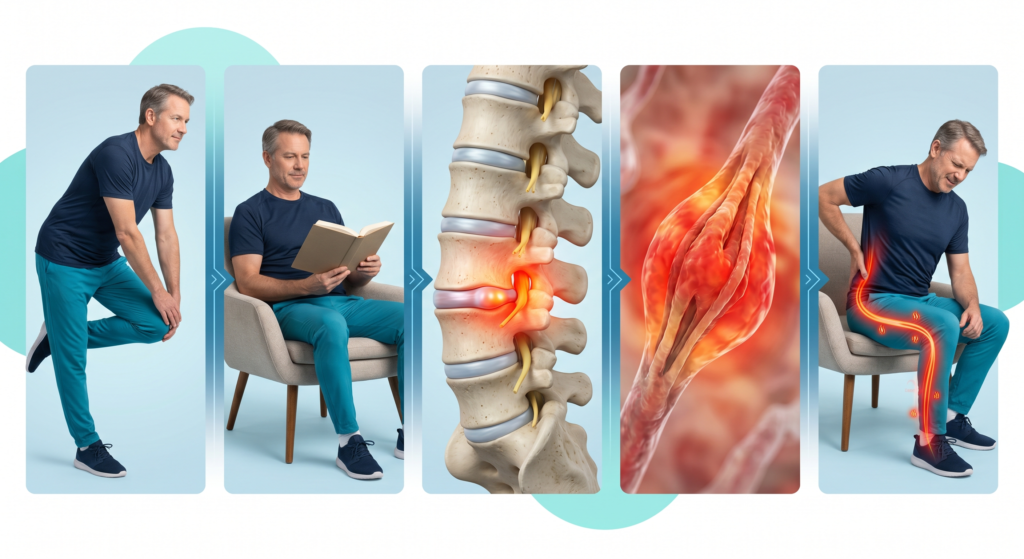
Why Sciatica Can Flare After Exercise or Stretching
A movement may feel acceptable during the activity but still irritate the nerve enough to cause a delayed flare-up.
Hamstring stretching may tension the nerve
What feels like a tight hamstring may actually involve sciatic nerve sensitivity. Aggressive stretching may provoke symptoms later.
Core exercises may increase disc pressure
Bracing, planking, crunching, or stabilizing too early may increase compression around an irritated disc and nerve root.
Sitting after exercise may worsen symptoms
Some patients feel acceptable during movement but flare once they sit afterward because disc pressure remains provocative.
Delayed inflammation may build
Symptoms that worsen two to four hours later may suggest that the nerve was irritated even if the activity felt tolerable.
Pressure-reduction option
How Spinal Decompression May Fit Sciatica Care
When sciatica is related to disc pressure, spinal decompression may be considered for selected patients as part of a personalized non-surgical plan.
Disc pressure
Decompression is designed to reduce mechanical pressure on selected spinal segments.
Nerve irritation
Reducing pressure may help create a calmer environment around an irritated nerve root in selected cases.
Movement tolerance
As symptoms become less reactive, patients may gradually tolerate safer movement strategies.
Technology-based care when appropriate
TAGMED Services That May Be Considered
Depending on the evaluation, selected patients may be considered for one or more non-surgical, non-invasive TAGMED services.
Spinal decompression
Controlled unloading designed to reduce mechanical pressure on selected spinal segments.
Specific osteopathy
Precise biomechanical care adapted to the patient’s presentation and tolerance.
Class IV medical laser
May be considered when clinically appropriate to support pain and inflammation management.
Precision percussion
Instrument-assisted treatment may be used selectively as part of a personalized plan.
Local access
Serving Montreal and Nearby Communities
Because decompression care may require repeated visits, this page is intended for patients who can realistically attend in-person care at the Montreal / Mont-Royal clinic.
Central Montreal
Mont-Royal, Outremont, Côte-des-Neiges, NDG, Westmount, Ville-Marie and nearby areas.
North and West Montreal
Saint-Laurent, Ahuntsic, Villeray, Laval, Dorval, Pointe-Claire and surrounding areas.
South Shore access
Longueuil, Brossard, Saint-Lambert and selected nearby communities within realistic driving distance.
- Montreal
- Mont-Royal
- Outremont
- Côte-des-Neiges
- NDG
- Westmount
- Saint-Laurent
- Ahuntsic
- Villeray
- Rosemont
- Laval
- Longueuil
- Brossard
- West Island
What to expect
How a Sciatica Evaluation Works
The evaluation helps determine whether your sciatica appears compatible with a disc-related, pressure-sensitive pattern.
1
Symptom mapping
We review where the pain travels and whether numbness, tingling, or weakness is present.
2
Trigger review
We identify whether sitting, bending, stretching, walking, coughing, or exercise aggravates symptoms.
3
Imaging review
If you already have MRI or other imaging reports, bring them to your appointment.
4
Personalized plan
If appropriate, a decompression-focused plan may be recommended based on your presentation and tolerance.
Safety first
When Sciatica Requires Urgent Medical Attention
Most sciatica cases are not emergencies, but some symptoms require immediate medical evaluation.
- Loss of bladder or bowel control
- Saddle numbness in the groin or inner thighs
- Rapidly worsening leg weakness
- Progressive foot drop
- Sudden severe weakness in both legs
- Fever with severe spinal pain
- Major trauma
- History of cancer with new severe spinal pain
Urgent care warning
If you experience bladder or bowel changes, saddle numbness, rapidly worsening weakness, or severe progressive neurological symptoms, seek urgent medical evaluation immediately.
Patient questions
Frequently Asked Questions About Sciatica Treatment in Montreal
Is sciatica treatment available at the Montreal clinic?
Yes. Clinique TAGMED Montreal / Mont-Royal evaluates selected patients with sciatica, radiating leg pain, numbness, tingling, and suspected disc-related nerve irritation.
Can spinal decompression help sciatica?
Spinal decompression may be appropriate for selected patients when sciatica appears related to disc pressure or nerve root irritation. A disc-focused evaluation is needed first.
Why does my sciatica get worse after stretching?
Some stretches may tension an irritated sciatic nerve or increase stress around a herniated disc. Relief during the stretch does not always mean the nerve is less irritated later.
Why does my sciatica get worse after sitting?
Sitting can increase sustained pressure through the lumbar spine. If the disc is pressure-sensitive, prolonged sitting may aggravate symptoms.
Do I need an MRI before booking?
An MRI can be helpful, but it is not always required before the first evaluation. If you already have imaging reports, bring them to your appointment.
Is this covered by RAMQ?
No. TAGMED services are private and are not covered by RAMQ. Receipts are issued for osteopathy and may be reimbursable by many private insurance plans, depending on your coverage.
Related resources