

Clinique TAGMED Montreal / Mont-Royal
Spinal Decompression Therapy in Montreal
Disc-Focused, Non-Surgical Care for Herniated Disc and Sciatica Patients in the Montreal Area
If you live in Montreal, Mont-Royal, Outremont, Côte-des-Neiges, Laval, Saint-Laurent, Rosemont, Ahuntsic, Villeray, NDG, Westmount, Longueuil, Brossard, or nearby areas, and you are still suffering from herniated disc or sciatica symptoms after trying other approaches, spinal decompression therapy may be worth evaluating.
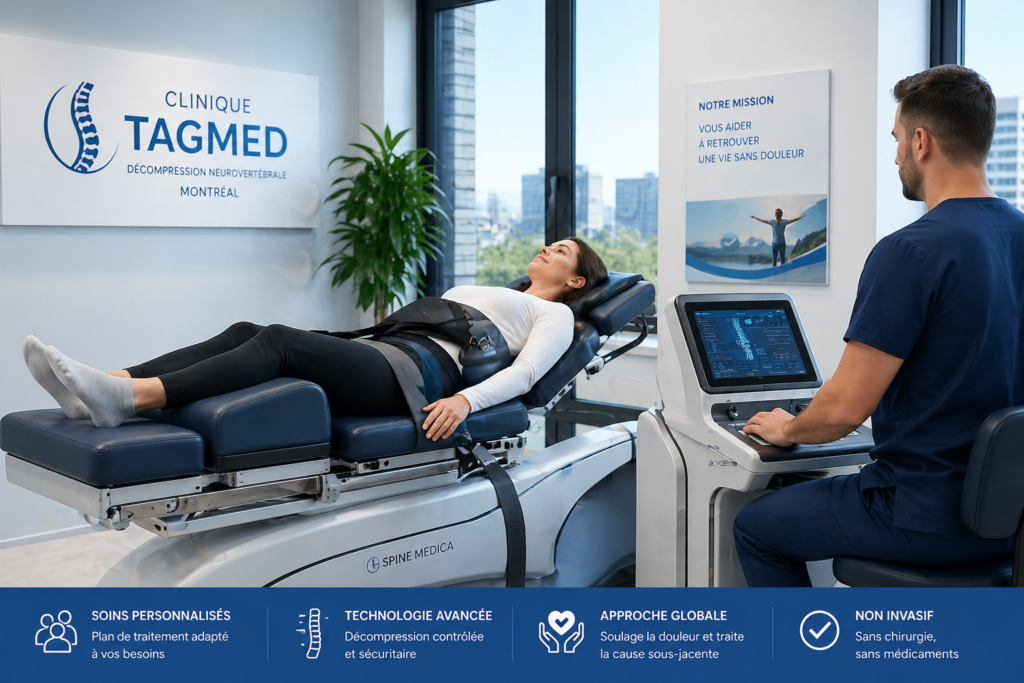
At Clinique TAGMED Montreal, Dr. Sylvain Desforges offers a disc-focused evaluation and non-surgical spinal decompression care for selected patients with persistent spinal pain, radiating leg pain, numbness, tingling, or pressure-sensitive disc symptoms.
The goal is not to force movement too early. The goal is to determine whether your disc needs a pressure-reduction strategy before strengthening, stretching, or more aggressive loading is introduced.
Treatment overview
What Is Spinal Decompression Therapy?
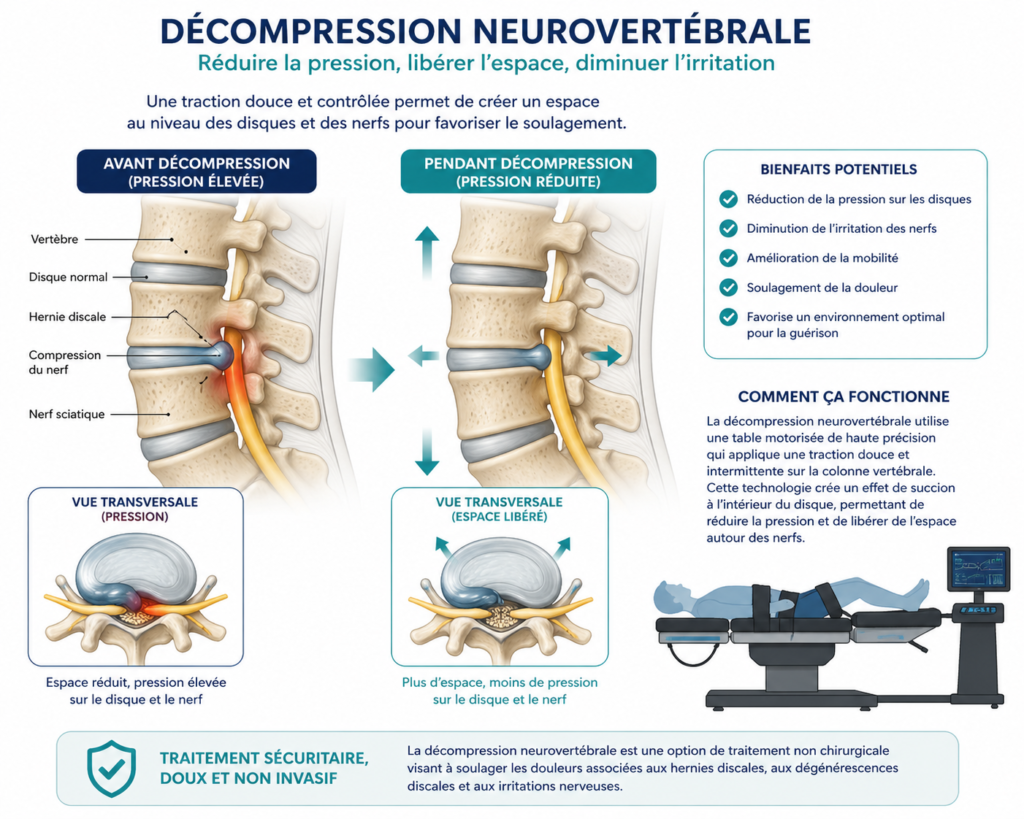
Spinal decompression therapy is a non-surgical, non-invasive approach designed to reduce mechanical pressure on selected spinal segments. It uses controlled traction to gently unload the spine and create a more favorable environment around irritated discs and nerve roots.
For patients with herniated disc symptoms, the problem is often not simply weakness or stiffness. The problem may involve intradiscal pressure, annular vulnerability, nerve irritation, inflammation, and protective muscle guarding.
This is why some patients feel worse after exercises that are supposed to help. If the disc is still mechanically reactive, adding compression too early may aggravate the problem instead of resolving it.
Who may benefit
Who May Consider Spinal Decompression in Montreal?
A disc-focused evaluation may be appropriate if you have symptoms such as:
- Persistent lower back pain with leg pain
- Sciatica that travels into the buttock, thigh, calf, or foot
- Numbness, tingling, burning, or electric-like symptoms
- Pain that worsens with sitting
- Pain that worsens after stretching
- Sciatica that flares after core exercises or gym-based routines
- MRI-confirmed herniated disc, disc protrusion, or bulging disc
- Symptoms that have not improved with previous conservative care
Clinical note: Spinal decompression is not appropriate for every patient. A proper evaluation is necessary to determine whether your symptoms fit a pressure-sensitive disc pattern and whether decompression is suitable for your condition.
Pressure-sensitive disc logic
Why Some Herniated Disc Patients Do Not Improve with Exercise Alone
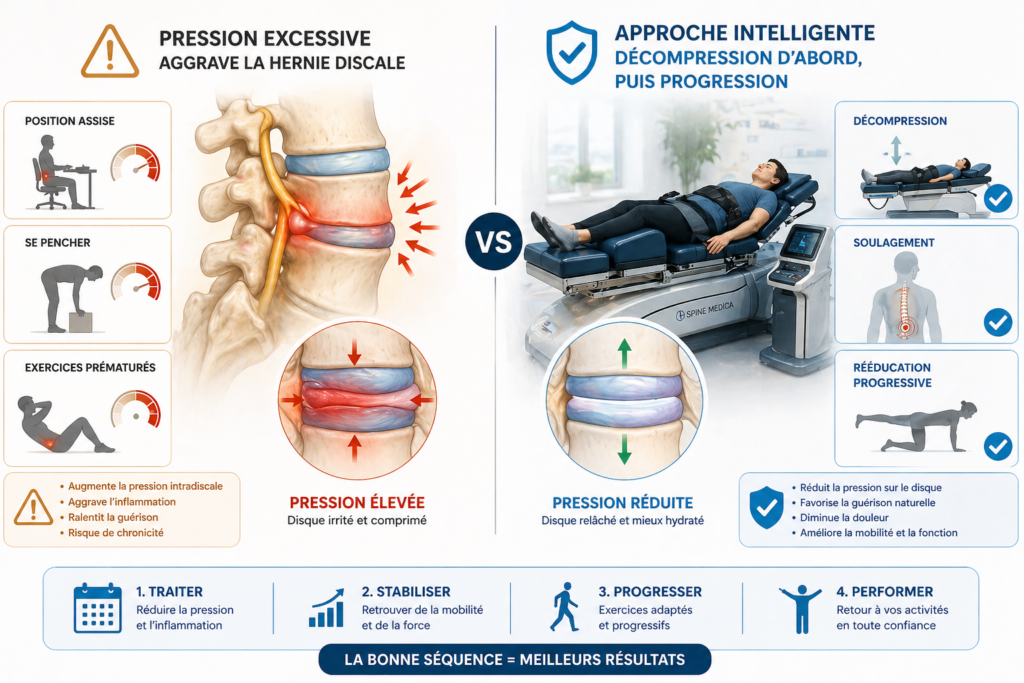
Many Montreal patients with herniated disc symptoms are told to strengthen their core, stretch their hamstrings, walk more, or resume therapeutic exercises. In the right phase, some movement can be useful. But in the active phase of a disc injury, timing matters.
A herniated disc is often a pressure-sensitive condition. If the outer ring of the disc is weakened or torn, increased intradiscal pressure may push disc material toward the irritated area. If a nerve root is already inflamed, repeated movement, flexion, compression, or stretching may restart the flare-up cycle.
This is the central idea explained in our authority guide: traditional exercises may become problematic when they are introduced before the disc and nerve are ready. Your existing pillar page already presents this “space first, movement later” model, with sections on intradiscal pressure, sciatica, core strengthening, stretching, red flags, and decompression-first logic.
Symptom pattern recognition
Common Signs That Your Disc May Still Be Mechanically Reactive
Your disc may still be too reactive for aggressive strengthening or stretching if you notice:
These patterns suggest that the issue may not be a lack of effort. The issue may be that the mechanical environment around the disc is not yet ready for progressive loading.
Clinical strategy
How Spinal Decompression Fits the “Space First” Strategy
Before a pressure-sensitive disc is strengthened, it may first need to be unloaded, calmed, and stabilized.
01
Unload
Reduce mechanical stress on the affected spinal segment.
02
Calm
Support a less irritated environment around the disc and nerve root.
03
Stabilize
Improve tolerance to basic movement before more demanding activity.
In selected patients, spinal decompression therapy aims to reduce mechanical stress on the affected spinal segment. This may help decrease irritation around the disc and nerve root, improve tolerance to basic movement, and support a gradual return to activity.
The goal is not to promise a cure. The goal is to create a safer mechanical environment so the body has a better opportunity to recover.
Conditions evaluated
Conditions Commonly Evaluated for Spinal Decompression
Patients commonly seek spinal decompression therapy in Montreal for conditions such as:
- Lumbar herniated disc
- L4-L5 herniated disc
- L5-S1 herniated disc
- Disc protrusion
- Bulging disc
- Sciatica related to disc irritation
- Degenerative disc-related pain
- Persistent low back pain with radiating symptoms
- Cervical disc irritation with arm symptoms, when clinically appropriate
TAGMED approach
What Makes Our Montreal Approach Different?
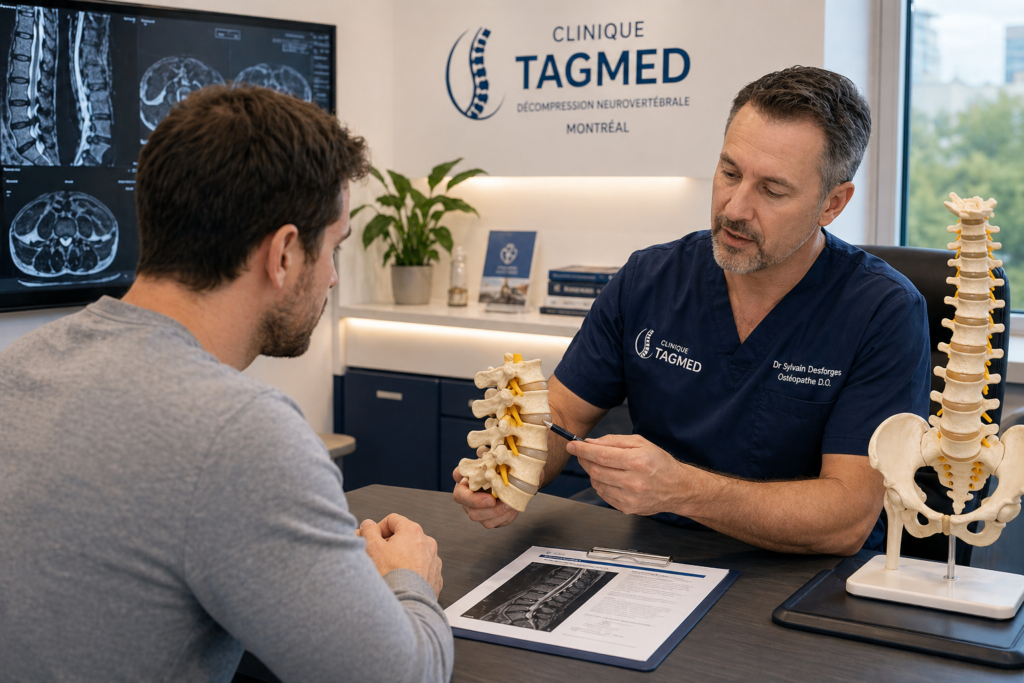
At Clinique TAGMED Montreal, the approach is not based on giving every patient the same exercise sheet. The first step is to understand how the disc behaves mechanically.
During a disc-focused evaluation, we look at factors such as:
- Where the pain travels
- Whether symptoms centralize or peripheralize
- Whether sitting, bending, coughing, or sneezing aggravates symptoms
- Whether stretching creates delayed flare-ups
- Whether previous exercise-based care worsened symptoms
- Whether the patient can realistically attend a decompression protocol
- Whether urgent medical red flags are present
This matters because spinal decompression therapy usually requires repeated visits. Patients should live within realistic driving distance of the Montreal clinic and be able to attend treatments consistently.
Local service area
Serving Montreal and Nearby Areas
The Montreal / Mont-Royal clinic is accessible for patients from:
Mont-Royal
Outremont
Côte-des-Neiges
Notre-Dame-de-Grâce
Westmount
Saint-Laurent
Ahuntsic
Villeray
Rosemont
Plateau-Mont-Royal
Ville-Marie
Laval
Longueuil
Brossard
West Island communities within reasonable driving distance
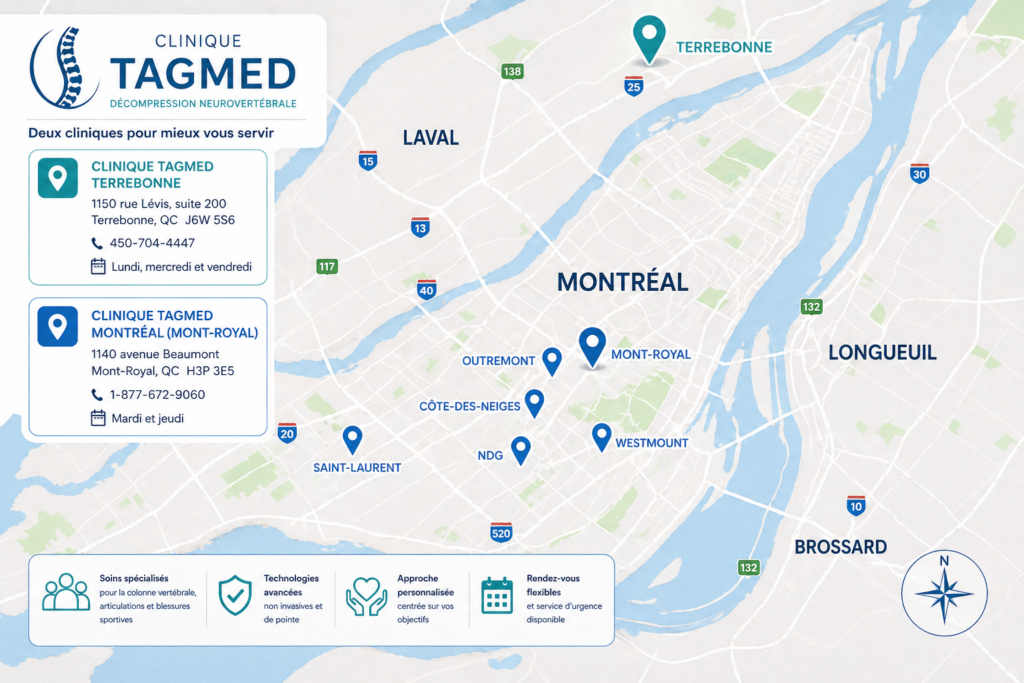
Because decompression care often requires multiple visits per week for several weeks, this page is intended for patients who can realistically attend care in person at the Montreal clinic.
Safety first
When Spinal Decompression May Not Be Appropriate
Spinal decompression is not appropriate for everyone. It may be contraindicated or require medical clearance in situations such as:
- Recent spinal fracture
- Spinal cancer or tumor
- Acute infection or fever
- Severe osteoporosis
- Pregnancy, depending on region and treatment type
- Unstable spinal condition
- Progressive neurological deficit
- Loss of bladder or bowel control
- Saddle anesthesia
Urgent warning: If you have loss of bladder or bowel control, numbness in the saddle area, rapidly worsening leg weakness, or severe progressive neurological symptoms, seek urgent medical evaluation immediately.
Common questions
Frequently Asked Questions
Is spinal decompression available in Montreal?
Yes. Clinique TAGMED offers spinal decompression care at the Montreal / Mont-Royal clinic for selected patients with herniated disc, sciatica, and pressure-sensitive spinal symptoms.
How often do patients usually need to come?
Spinal decompression protocols often require repeated visits, commonly more than once per week over several weeks. This is why patients should live within realistic driving distance of the Montreal clinic.
Is spinal decompression the same as exercise therapy?
No. Exercise therapy loads and activates the body. Spinal decompression is designed to reduce mechanical pressure on selected spinal segments. The two approaches may belong to different phases of care.
Can spinal decompression help a herniated disc?
Spinal decompression may be appropriate for selected patients with disc-related symptoms. A disc-focused evaluation is needed to determine whether your condition fits this type of mechanical approach.
What if physiotherapy-style exercises made my sciatica worse?
If exercises repeatedly worsen your sciatica, your disc may still be mechanically reactive. In that case, a decompression-first evaluation may help determine whether loading was introduced too early.
What if injections helped temporarily but the pain returned?
Injections may reduce inflammation, but they do not necessarily address the mechanical pressure around the disc. If symptoms return, it may be useful to evaluate whether disc pressure remains a contributing factor.
Do I need an MRI before booking?
An MRI can be helpful, but it is not always required before the first evaluation. If you already have imaging reports, bring them to your appointment.
Is this treatment covered by RAMQ?
No. TAGMED services are private and are not covered by RAMQ. Receipts are issued for osteopathy and may be reimbursable by many private insurance plans, depending on your coverage.
Related resources