

Clinique TAGMED Terrebonne
Tried Everything for a Herniated Disc in Terrebonne?
A disc-focused, non-surgical evaluation for selected North Shore patients whose herniated disc or sciatica symptoms have not improved with previous care.
If you have tried exercises, stretching, medication-based strategies, injection-based care, manual therapy, rest, ergonomic changes, or general back-pain advice and your herniated disc or sciatica still keeps returning, the missing piece may be mechanical pressure. At Clinique TAGMED Terrebonne, Dr. Sylvain Desforges evaluates selected patients to determine whether a decompression-first strategy may be appropriate.
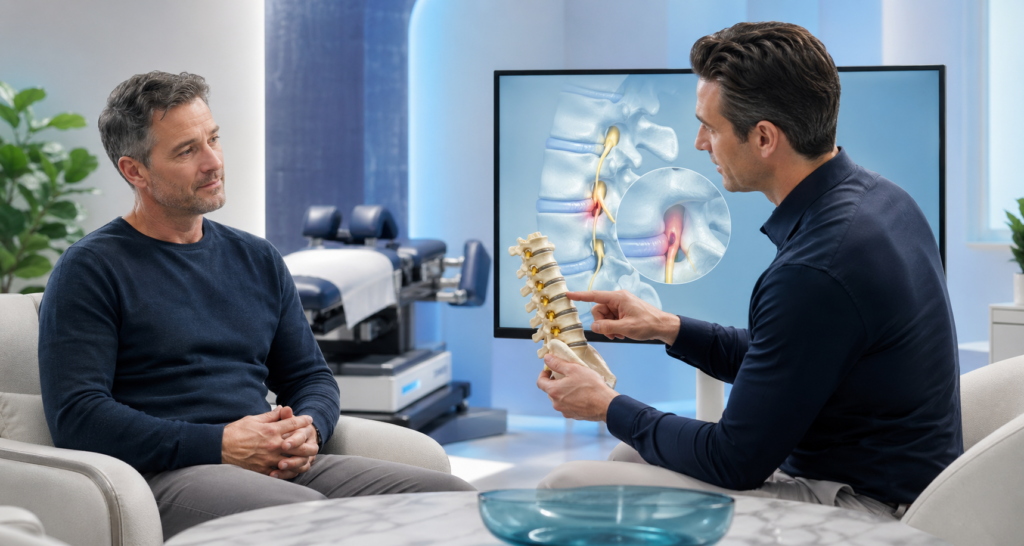
When nothing seems to hold
If every treatment gives only temporary relief, the disc may still be mechanically reactive.
Many patients with persistent herniated disc symptoms feel discouraged. They may have tried strengthening, stretching, rest, medication-based strategies, injection-based care, manual therapy, online exercises, ergonomic changes, or repeated appointments without lasting improvement.
This does not necessarily mean that the patient has failed. It may mean that the treatment sequence has not matched the mechanical state of the disc. A pressure-sensitive disc may not tolerate strengthening, stretching, prolonged sitting, twisting, lifting, or bracing until the mechanical environment becomes calmer.
At Clinique TAGMED Terrebonne, the objective is to evaluate whether your symptoms fit a disc-pressure pattern, nerve irritation pattern, or another presentation that may require a different sequence of care.
Why symptoms persist
Why Herniated Disc Pain Can Persist After Multiple Treatments
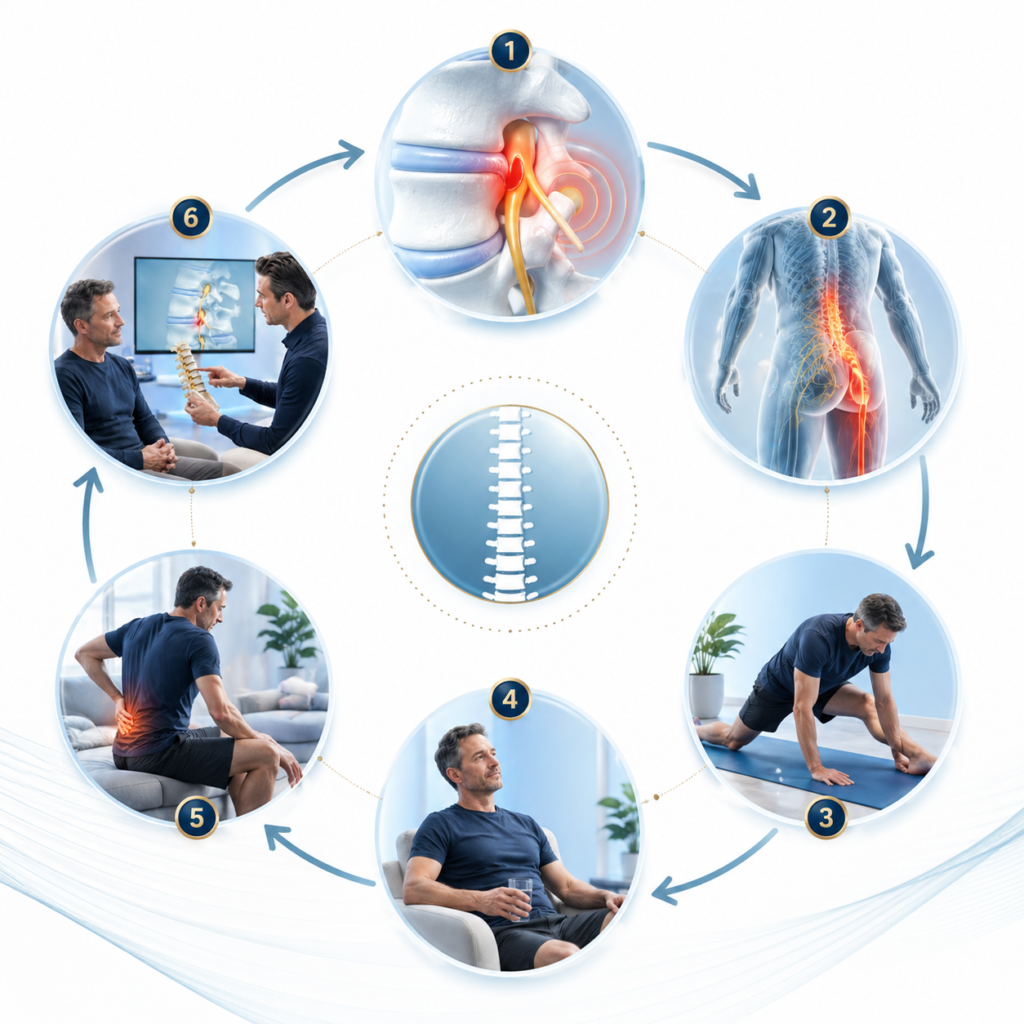
Persistent disc pain may continue when inflammation, pressure, nerve irritation, daily loading, sitting intolerance, and exercise timing are not addressed in the right order.
The disc may still be pressure-sensitive
If sitting, driving, bending, lifting, bracing, or stretching keeps triggering symptoms, the disc may still be mechanically reactive.
The nerve may still be irritated
Sciatica, numbness, tingling, burning, or electric symptoms may suggest that a nerve root remains sensitive.
The sequence may have been wrong
Strengthening, stretching, or loading may be useful later, but may fail when introduced before the disc is ready.
Common patient history
What Many Patients Have Already Tried Before Seeing Us
Patients who reach this page often feel discouraged because they have already made serious efforts to recover.
- Core strengthening that increased symptoms
- Hamstring or low back stretching with temporary relief only
- Rest that helped briefly but did not restore function
- Medication-based strategies with incomplete or temporary relief
- Injection-based care where symptoms returned later
- Manual therapy that did not create lasting improvement
- Online exercises that triggered flare-ups
- Eronomic changes that were not enough
- Walking programs limited by leg pain or numbness
- Repeated flare-ups after sitting, bending, lifting, or driving
A long treatment history does not mean that your condition is hopeless. It may mean that your disc has not yet been evaluated through the right mechanical lens.
A different clinical question
The Question Is Not Only “How Do We Reduce Pain?”
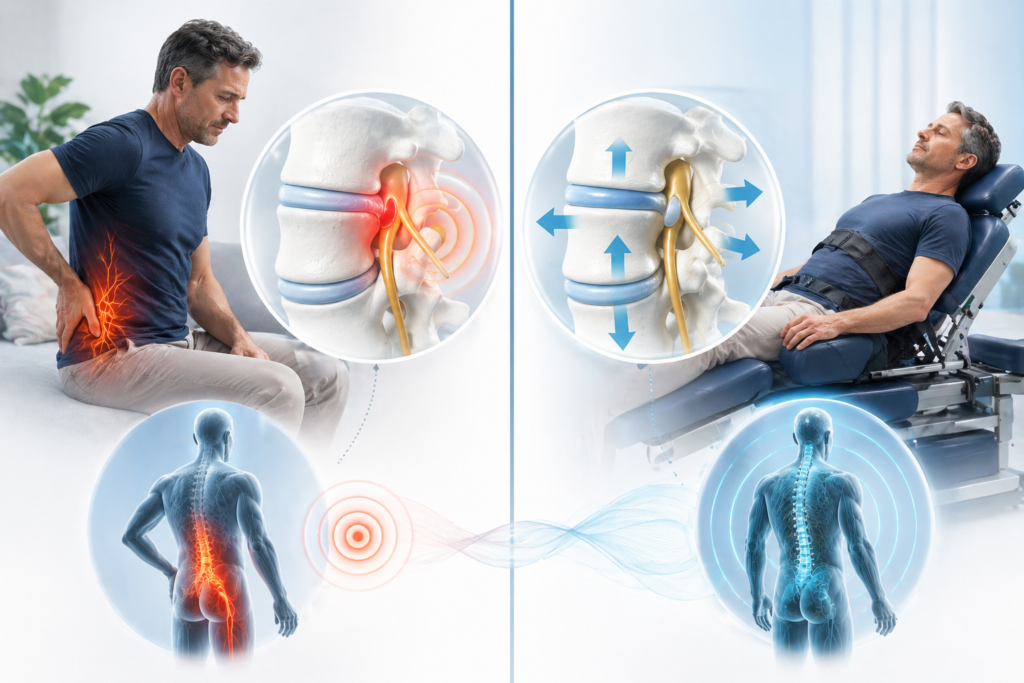
Pain matters. But with a herniated disc, the deeper question may be: what keeps re-irritating the disc and nerve?
Pain-focused care may provide temporary relief
Some approaches may reduce pain perception, inflammation, or muscle guarding for a period of time.
Pressure-focused care addresses mechanics
A decompression-first approach asks whether mechanical pressure is still contributing to disc and nerve irritation.
Exercise may be mistimed
Strengthening a reactive disc too early may increase compression before the tissue is ready.
Stretching may restart the cycle
Stretching may feel relieving yet still tension an irritated sciatic nerve and trigger delayed symptoms.
TAGMED clinical approach
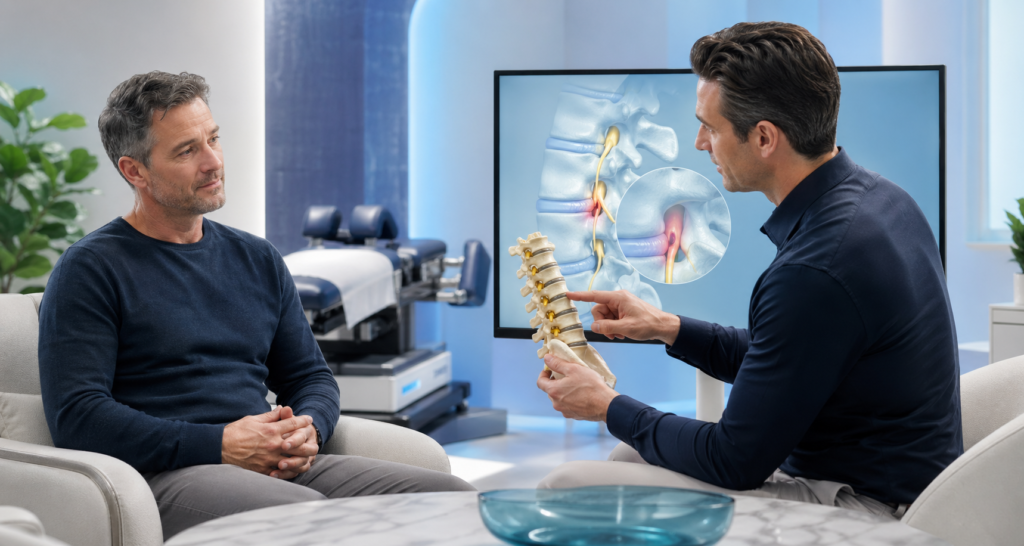
Our Strategy: Re-Evaluate the Disc, Not Just the Pain
When patients have tried many approaches without lasting improvement, we look at the mechanical behavior of the disc and nerve.
“Before a pressure-sensitive disc is progressively loaded, it may first need to be calmed, unloaded, and evaluated.”
1
Review what failed
We identify which approaches gave temporary relief, which worsened symptoms, and which did not change function.
2
Identify mechanical triggers
We assess whether sitting, driving, bending, stretching, bracing, or loading keeps reproducing symptoms.
3
Consider decompression
When appropriate, spinal decompression may be considered as part of a pressure-reduction strategy.
Pressure-reduction option
How Spinal Decompression May Fit When You Have Tried Everything
Spinal decompression is designed to gently unload selected spinal segments using controlled traction. It may be considered when the evaluation suggests that mechanical pressure contributes to persistent or recurring symptoms.
Different mechanical goal
Many approaches try to reduce pain or increase movement. Decompression focuses on reducing mechanical pressure in selected cases.
Disc and nerve environment
Reducing pressure may help create a less provocative environment around an irritated disc and nerve root.
Better sequencing
Movement, stabilization, and strengthening may be reconsidered later, once symptoms are less reactive.
When to consider evaluation
Patterns That Suggest Your Disc May Still Be Reactive
These patterns may suggest that your symptoms require a more disc-specific evaluation.
- Pain returns after temporary relief
- Sciatica keeps traveling into the leg or foot
- Sitting or driving remains difficult
- Stretching feels good but symptoms return worse later
- Core exercises or bracing increase pain
- Symptoms flare after bending, lifting, or twisting
- Numbness or tingling persists
- Flare-ups occur two to four hours after activity
- You feel stuck between exercise, injections, and surgery discussions
- You want a non-surgical, disc-focused evaluation
Conditions commonly evaluated
Disc-Related Conditions We Commonly Evaluate
Patients commonly seek a disc-focused evaluation when persistent symptoms interfere with sitting, driving, walking, work, and sleep.
- Lumbar herniated disc
- L4-L5 herniated disc
- L5-S1 herniated disc
- Disc protrusion
- Bulging disc
- Sciatica
- Radiating leg pain
- Numbness and tingling
- Disc-related low back pain
- Persistent symptoms after previous care
What to expect
How the Evaluation Works
The evaluation is designed to understand why symptoms keep returning and whether a decompression-based strategy may be appropriate.
1
Review previous care
We review what you tried, what helped temporarily, and what made symptoms worse.
2
Map symptoms
We evaluate where symptoms travel and whether leg pain, numbness, tingling, or weakness is present.
3
Assess triggers
We assess whether sitting, bending, stretching, driving, or loading still provokes symptoms.
4
Plan next steps
If appropriate, a decompression-focused plan may be recommended based on your presentation.
Local access
Serving Terrebonne and Nearby North Shore Communities
Because decompression care may require repeated visits, this page is intended for patients who can realistically attend in-person care at the Terrebonne clinic.
- Terrebonne
- Mascouche
- Repentigny
- Laval
- Blainville
- Boisbriand
- Sainte-Thérèse
- Rosemère
- Lorraine
- Saint-Eustache
- Saint-Jérôme
- Anjou
- Montréal-Nord
- Rivière-des-Prairies
Safety first
When Herniated Disc Symptoms Require Urgent Medical Attention
Most herniated disc cases are not emergencies, but some symptoms require immediate medical evaluation.
- Loss of bladder or bowel control
- Saddle numbness in the groin or inner thighs
- Rapidly worsening leg weakness
- Progressive foot drop
- Sudden severe weakness in both legs
- Fever with severe spinal pain
- Major trauma
- Severe progressive neurological symptoms
Urgent care warning
If you experience bladder or bowel changes, saddle numbness, rapidly worsening weakness, or severe progressive neurological symptoms, seek urgent medical evaluation immediately.
Patient questions
Frequently Asked Questions About Persistent Herniated Disc Pain
What if I already tried everything for my herniated disc?
If previous care did not provide lasting improvement, it may be useful to evaluate whether mechanical disc pressure or nerve irritation is still active.
Does trying many treatments mean surgery is the only option?
Not necessarily. Some patients may still be candidates for non-surgical, disc-focused care. However, urgent neurological symptoms require immediate medical evaluation.
Can spinal decompression help after other treatments failed?
Spinal decompression may be appropriate for selected patients when symptoms suggest persistent disc pressure or nerve irritation. A disc-focused evaluation is needed first.
Why did exercises, injections, or stretching only help temporarily?
Temporary relief may occur when pain or inflammation decreases, but symptoms can return if the mechanical pressure around the disc and nerve remains active.
Do I need an MRI before booking?
An MRI can be helpful, but it is not always required before the first evaluation. If you already have imaging reports, bring them to your appointment.
Is this covered by RAMQ?
No. TAGMED services are private and are not covered by RAMQ. Receipts are issued for osteopathy and may be reimbursable by many private insurance plans, depending on your coverage.
Related resources