

Herniated disc and stretching flare-ups
Why Herniated Disc Pain Gets Worse After Stretching
A disc-focused explanation for patients whose back pain, sciatica, leg pain, numbness, or tingling worsens after stretching.
If stretching feels good at first but your herniated disc pain or sciatica worsens later, the stretch may be irritating an already sensitive nerve root or increasing stress on a pressure-sensitive disc. Relief during a stretch does not always mean the disc is improving.
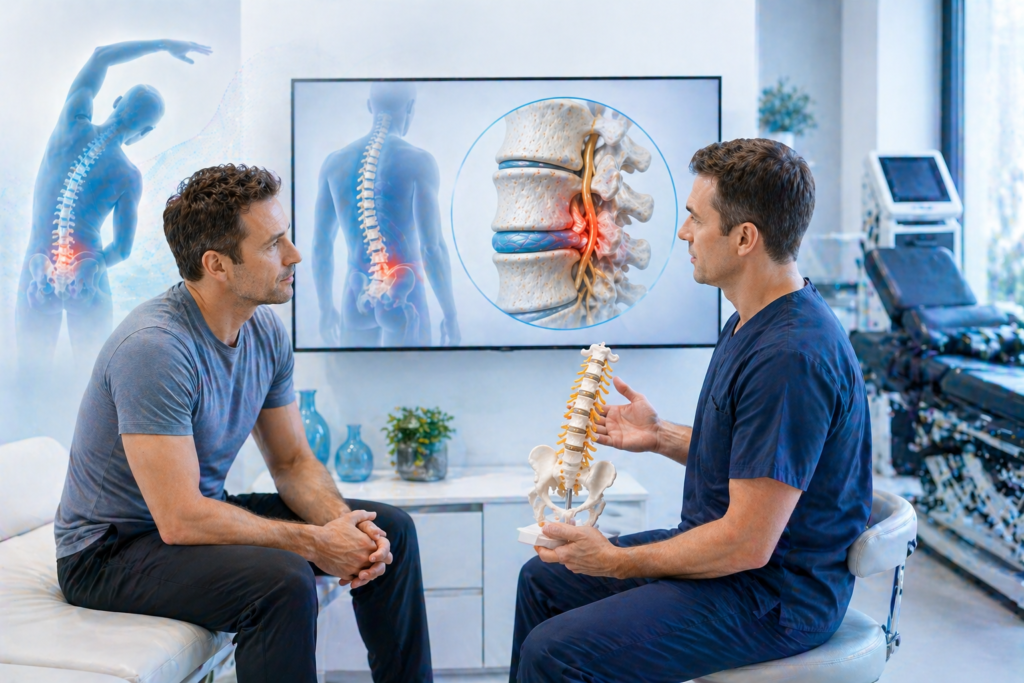
The false relief problem
Stretching can feel relieving in the moment and still trigger a flare-up later.
Many patients stretch because their leg, hamstring, buttock, or lower back feels tight. The stretch may create a temporary sensation of release, but in disc-related sciatica, that tight feeling may actually involve an irritated nerve root rather than a simple tight muscle.
When a herniated disc is still reactive, aggressive stretching may increase neural tension, lumbar flexion, disc pressure, or mechanical friction around the nerve. This is why some patients feel better during the stretch, then worse two to four hours later or the next morning.
At Clinique TAGMED, Dr. Sylvain Desforges evaluates selected patients with stretching-related flare-ups to determine whether their symptoms suggest a pressure-sensitive disc pattern and whether spinal decompression may be appropriate as part of a personalized non-surgical plan.
Why symptoms flare
Why Stretching Can Make a Herniated Disc Worse
Stretching can become provocative when it tensions an irritated nerve, increases lumbar flexion, or compresses a disc that is not ready for that movement.
It may tension the sciatic nerve
Hamstring stretches, toe touches, and straight-leg movements may pull on an already irritated sciatic nerve pathway.
It may increase lumbar flexion
Knee-to-chest movements, deep forward bends, and rounded-back stretches may increase stress on a vulnerable lumbar disc.
It may trigger delayed inflammation
Symptoms may worsen later as the irritated nerve reacts, even if the stretch felt relieving at the time.
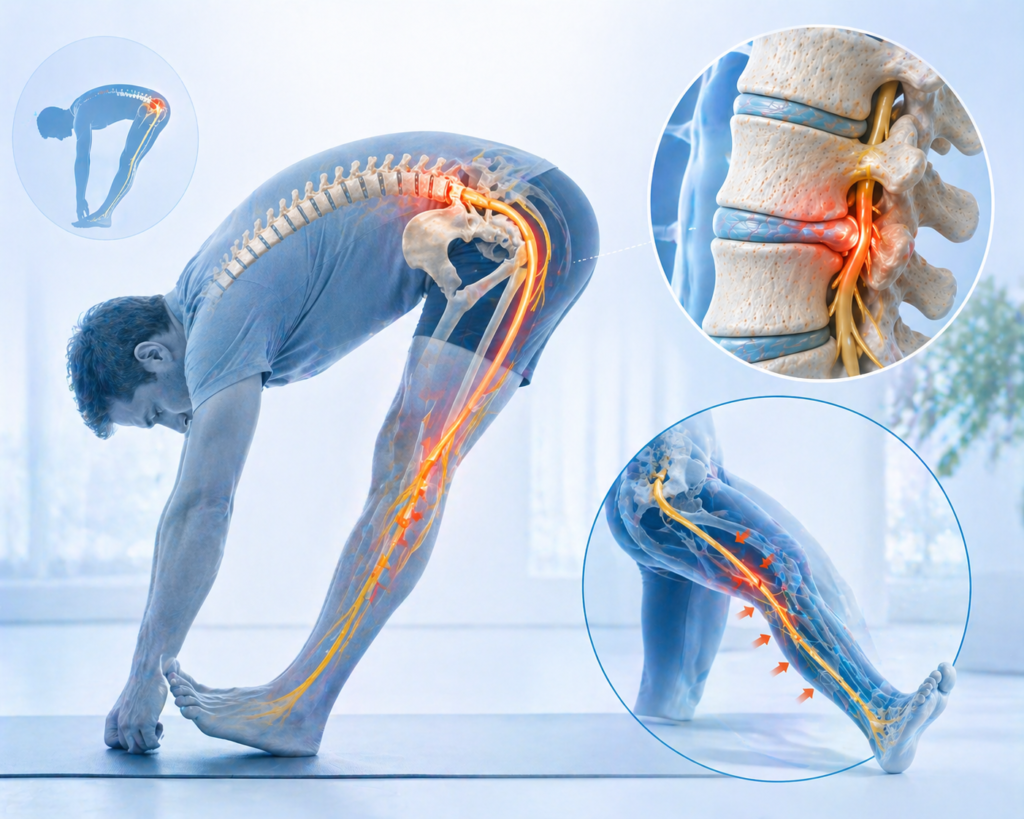
Common provocative movements
Stretches That May Flare a Reactive Herniated Disc
These stretches are not always harmful. The issue is whether they are being used before the disc and nerve are ready.
- Hamstring stretching that reproduces leg pain
- Toe-touch stretching
- Knee-to-chest movements
- Deep seated forward bends
- Piriformis stretching that increases sciatica
- Yoga poses involving deep flexion
- Twisting stretches
- Long-duration static stretching
- Stretching followed by prolonged sitting
- Repeated stretching every time symptoms return
The key question is not only whether the stretch feels relieving. The more important question is whether symptoms return worse later.
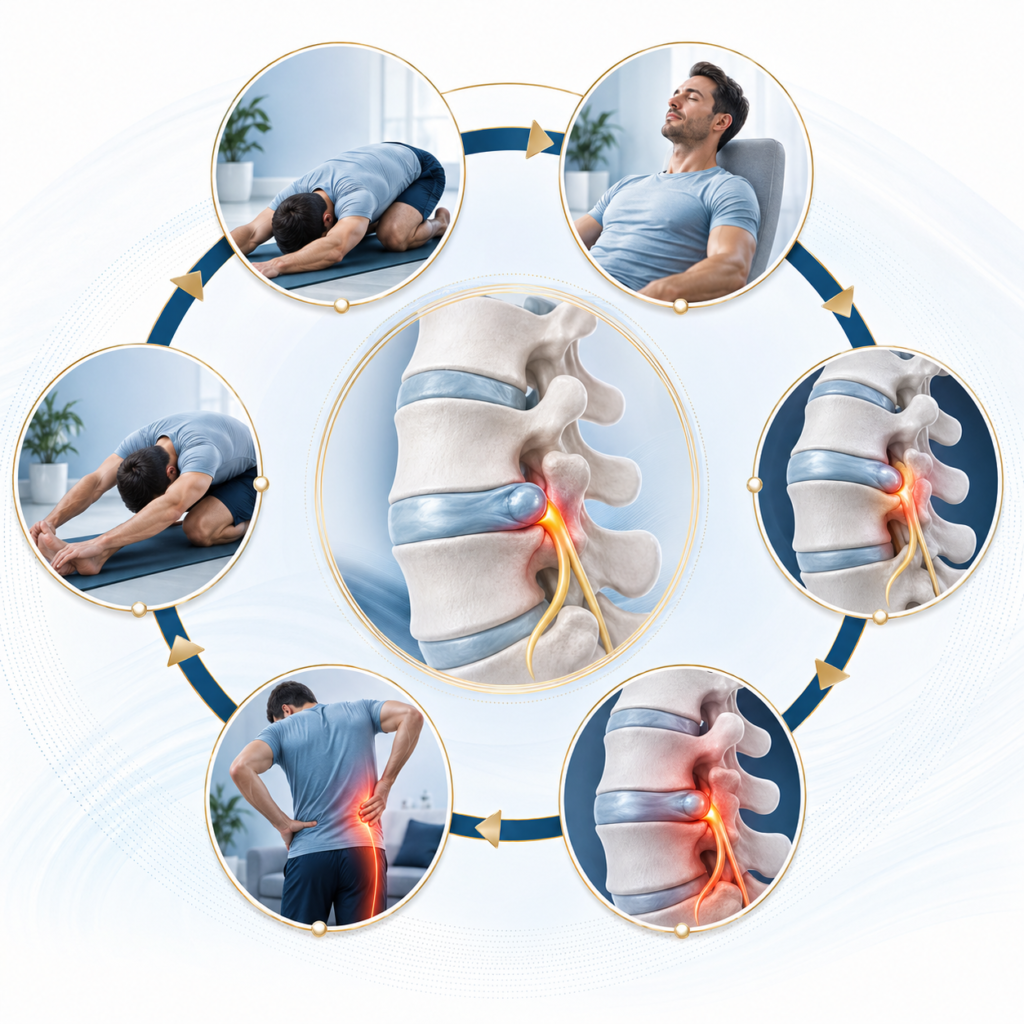
The false relief cycle
Why Stretching Can Create a Repeating Flare-Up Pattern
Some patients become trapped in a cycle: stretch, feel temporary relief, flare later, then stretch again because the body feels tight.
1
Stretch feels helpful
The patient feels a temporary release or pulling sensation.
2
The nerve is irritated
The stretch may still tension the nerve or stress the disc.
3
Symptoms flare later
Inflammation and nerve sensitivity may build over hours.
4
The cycle repeats
The patient stretches again because the area feels tight.
Disc and nerve mechanics
What Feels Like Tightness May Actually Be Nerve Sensitivity
A tight hamstring, tight glute, or tight lower back may sometimes be the body’s protective response to an irritated nerve root or pressure-sensitive disc.
Muscle tightness is often local
A simple muscle problem usually stays more localized and often improves predictably with gentle progressive loading and recovery.
Nerve irritation can travel
Disc-related sciatica may travel into the buttock, thigh, calf, ankle, foot, or toes, often with burning, tingling, or electric sensations.
TAGMED clinical approach
Our Strategy: Calm the Disc and Nerve Before Aggressive Stretching
If stretching keeps worsening herniated disc symptoms, the next step is not always more stretching. In selected cases, the first priority may be to reduce pressure and calm nerve irritation.
“Before an irritated nerve is challenged with stretching, it may first need less pressure, less tension, and a calmer mechanical environment.”
1
Identify stretch triggers
We review which stretches reproduce symptoms, which movements create delayed flare-ups, and how the leg pain behaves afterward.
2
Reduce pressure
When appropriate, spinal decompression may be considered to reduce mechanical stress around selected spinal segments.
3
Reintroduce movement later
Movement and flexibility work may be reconsidered when symptoms are less reactive and better tolerated.
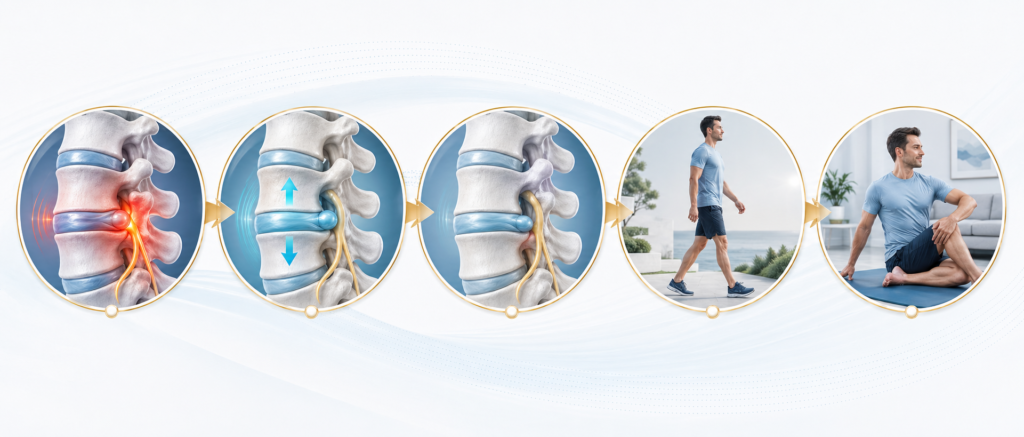
Pressure-reduction option
How Spinal Decompression May Fit Stretching-Related Disc Pain
When stretching-related pain is associated with a herniated disc or sciatica, spinal decompression may be considered for selected patients after a disc-focused evaluation.
Reduce mechanical pressure
Decompression is designed to unload selected spinal segments rather than repeatedly tensioning irritated tissues.
Calm nerve irritation
In selected cases, reducing pressure may help create a less provocative environment around an irritated nerve root.
Improve movement tolerance
As symptoms become less reactive, movement strategies may be reassessed gradually and carefully.
Who should consider evaluation
When to Book a Disc-Focused Evaluation
A disc-focused evaluation may be appropriate if stretching consistently triggers or worsens a herniated disc or sciatica pattern.
- Sciatica worsens after stretching
- Leg pain travels farther after stretching
- Symptoms worsen two to four hours later
- Stretching gives only temporary relief
- Hamstring stretches reproduce nerve pain
- Knee-to-chest movements worsen symptoms
- Numbness or tingling increases after stretching
- You have a known or suspected herniated disc
Safety first
When Stretching-Related Disc Pain Requires Urgent Medical Attention
Most stretching-related flare-ups are not emergencies, but some symptoms require immediate medical evaluation.
- Loss of bladder or bowel control
- Saddle numbness in the groin or inner thighs
- Rapidly worsening leg weakness
- Progressive foot drop
- Sudden severe weakness in both legs
- Fever with severe spinal pain
- Major trauma
- Severe progressive neurological symptoms
Urgent care warning
If you experience bladder or bowel changes, saddle numbness, rapidly worsening weakness, or severe progressive neurological symptoms, seek urgent medical evaluation immediately.
Patient questions
Frequently Asked Questions About Herniated Disc Pain Worse After Stretching
Why does stretching make my herniated disc pain worse?
Stretching may worsen symptoms if it increases nerve tension, lumbar flexion, disc pressure, or irritation around an already sensitive nerve root.
Why does stretching feel good at first but worse later?
Stretching may create temporary relief while still irritating the nerve. Symptoms can worsen later as inflammation and nerve sensitivity build.
Does this mean stretching is always bad for a herniated disc?
No. Stretching may be appropriate later for selected patients. The issue is timing, tissue tolerance, and whether the disc and nerve are still reactive.
Can spinal decompression help if stretching worsens sciatica?
Spinal decompression may be appropriate for selected patients when symptoms suggest disc pressure or nerve root irritation. A disc-focused evaluation is needed first.
Should I keep stretching if it gives temporary relief?
If symptoms return worse later, repeated stretching may be part of the flare-up cycle. This pattern should be evaluated carefully.
Is this covered by RAMQ?
No. TAGMED services are private and are not covered by RAMQ. Receipts are issued for osteopathy and may be reimbursable by many private insurance plans, depending on your coverage.
Related resources