

Clinique TAGMED Montreal / Mont-Royal
Herniated Disc Treatment After Failed Physiotherapy in Montreal
Disc-focused, non-surgical care for selected patients whose herniated disc or sciatica symptoms did not improve with previous exercise-based care.
If you live in Montreal, Mont-Royal, Outremont, Côte-des-Neiges, Laval, Saint-Laurent, Ahuntsic, Villeray, Rosemont, NDG, Westmount, Longueuil, Brossard, or nearby areas, and your herniated disc or sciatica symptoms became worse or failed to improve after exercise-based care, a disc-focused evaluation may help determine whether your disc still needs a pressure-reduction strategy before more loading is introduced.
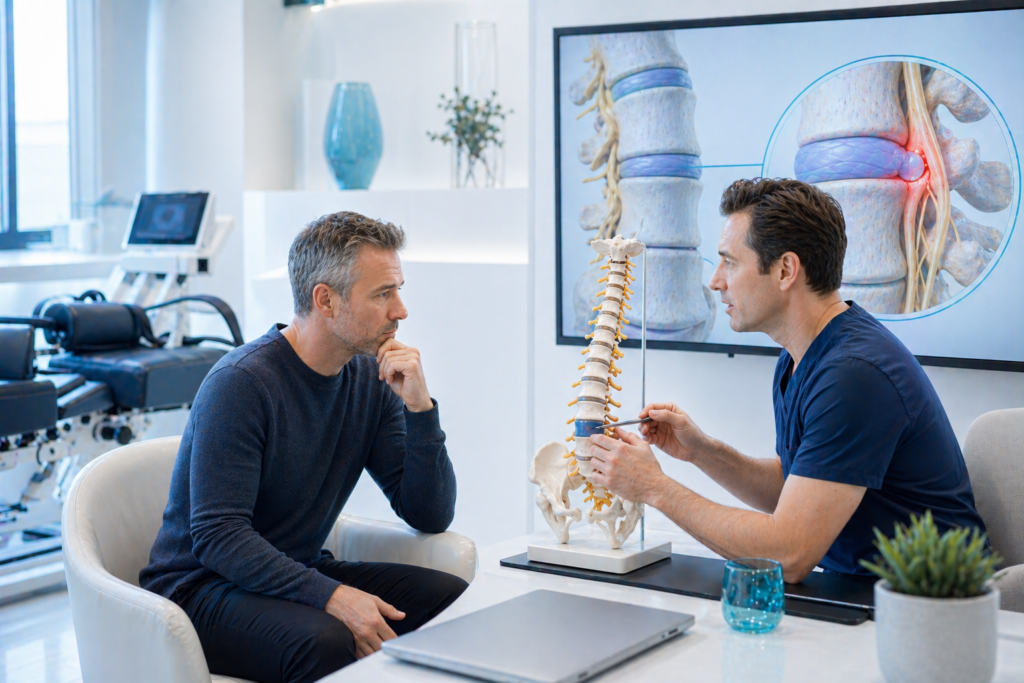
When exercise-based care did not help
If your symptoms worsened after exercises, the problem may not be weakness. It may be timing.
Many patients with herniated disc symptoms are told to strengthen their core, stretch their hamstrings, stay active, or begin exercise-based rehabilitation. In the right phase, some movement may be useful. But when a disc is actively irritated, pressure-sensitive, or causing sciatica, loading the spine too early may aggravate symptoms.
At Clinique TAGMED Montreal / Mont-Royal, Dr. Sylvain Desforges evaluates selected patients who have persistent disc-related symptoms after previous care. The goal is to determine whether the disc may still require decompression, protection, and a calmer mechanical environment before progressive movement becomes appropriate.
This page is not a criticism of exercise. It is an explanation of why the wrong exercise at the wrong time may fail when the real issue is disc pressure, nerve irritation, and tissue tolerance.
The common missing factor
Why Exercise-Based Care May Fail With an Active Herniated Disc
Exercise-based care often assumes that the main problem is weakness, stiffness, or poor conditioning. In a herniated disc, the dominant problem may be pressure and nerve irritation.
The disc may still be reactive
If the disc is still irritated, flexion, compression, rotation, or bracing may continue to provoke symptoms.
The nerve may be hypersensitive
Sciatica can involve an irritated nerve root. Even gentle stretches may become provocative if they increase neural tension.
The timing may be wrong
A useful exercise later in recovery may still be inappropriate if introduced while the disc and nerve are still inflamed.
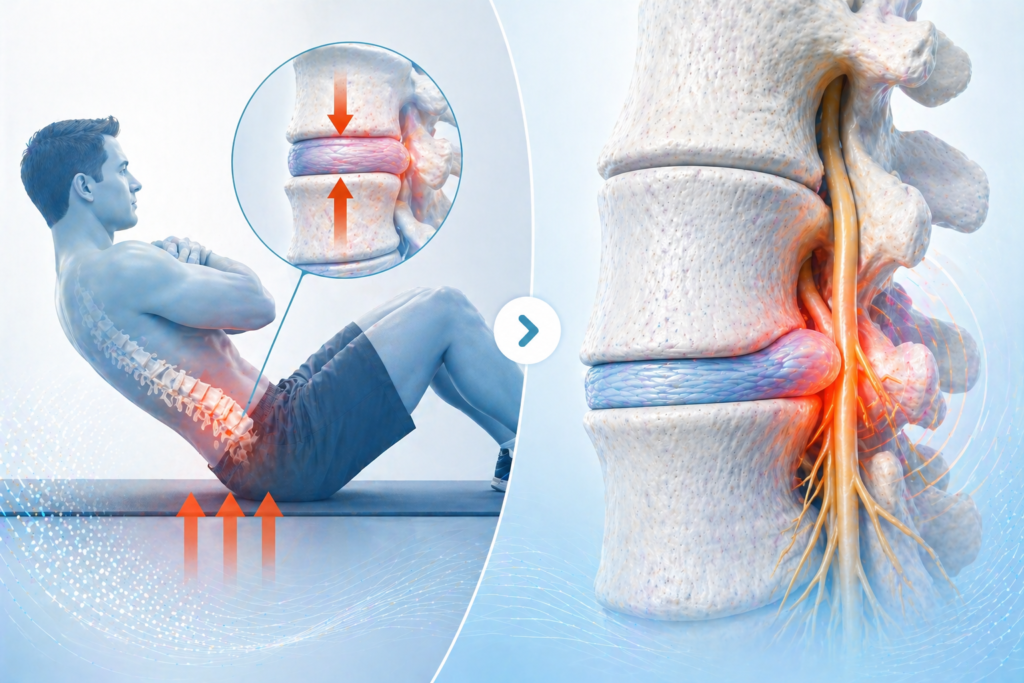
Warning signs after previous care
Signs That Exercise May Have Been Introduced Too Early
Your previous care may have been too provocative for the disc stage if symptoms repeatedly worsened during or after exercise.
- Sciatica increased after core exercises
- Leg pain traveled farther down the thigh, calf, or foot
- Numbness or tingling increased after movement
- Stretching felt good temporarily but caused flare-ups later
- Back spasms increased after exercise sessions
- Sitting became worse after workouts or stretching
- Symptoms worsened two to four hours later
- Pain was worse the next morning
- Exercises seemed easy but still triggered delayed irritation
- You needed more medication or rest after exercise-based care
A movement is not automatically safe because it feels acceptable during the exercise. The true test is how your disc and nerve respond later that day and the next morning.
Biomechanical explanation
A Herniated Disc Is Often a Pressure Problem Before It Is a Strength Problem
A herniated disc behaves differently from a simple muscular strain. The disc is a pressure-sensitive structure located near nerve tissue.
Exercise can increase compression
Core bracing, planks, sit-ups, squats, or resistance exercises may increase pressure through the injured segment.
Stretching can increase nerve tension
Hamstring stretching, knee-to-chest movements, toe touches, or deep flexion may irritate an already sensitive nerve root.
Sitting can maintain disc stress
Many patients flare after care because sitting afterward continues to load the lumbar spine.
Delayed flare-ups are clinical clues
If pain worsens hours later, the movement may have exceeded the tissue tolerance even if it felt acceptable at the time.
TAGMED clinical approach
Our Strategy: Decompression Before Loading When Appropriate
If exercise-based care failed because the disc was still mechanically reactive, the next step is not necessarily harder exercise. It may be a better sequence.
“Before a pressure-sensitive disc is progressively loaded, it may first need to be calmed, unloaded, and evaluated.”
1
Identify the failed pattern
We review which movements, exercises, stretches, or positions made symptoms worse.
2
Reduce mechanical irritation
When appropriate, decompression may be considered to reduce pressure around the irritated disc and nerve root.
3
Rebuild later
Movement and stabilization may be reintroduced only when symptom behavior suggests better tolerance.
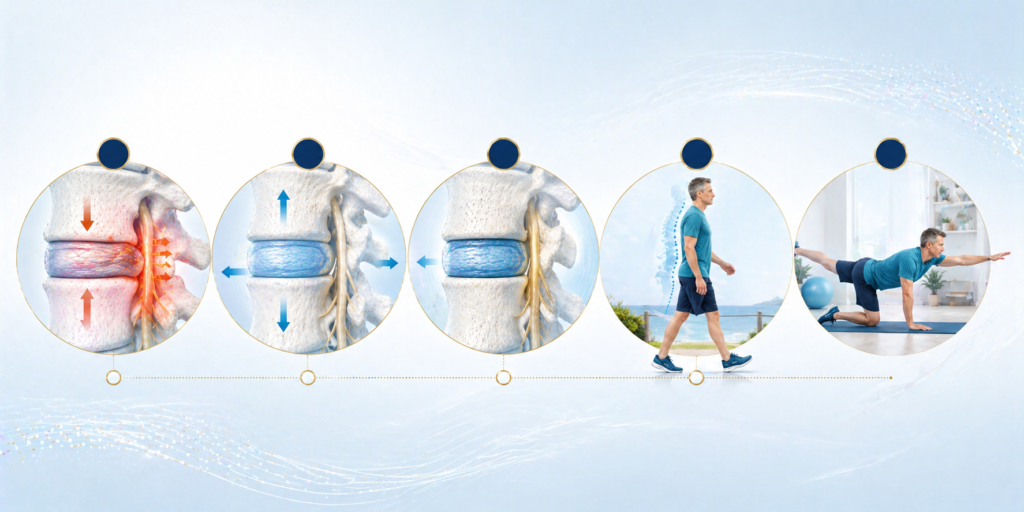
Pressure-reduction option
How Spinal Decompression May Fit After Failed Exercise-Based Care
Spinal decompression is designed to gently unload selected spinal segments using controlled traction. It may be considered when the evaluation suggests that disc pressure contributes to persistent symptoms.
Different mechanical goal
Exercise often adds load. Decompression aims to reduce mechanical pressure around selected spinal segments.
Disc and nerve environment
In selected patients, reducing pressure may help create a less provocative environment around the irritated disc and nerve.
Stepwise recovery
Decompression may help support a sequence where movement and loading are reconsidered later, not forced immediately.
Conditions commonly evaluated
Disc-Related Conditions We Commonly Evaluate After Failed Exercise-Based Care
Patients commonly seek a disc-focused evaluation when previous care did not resolve symptoms that interfere with sitting, driving, walking, work, and sleep.
- Lumbar herniated disc
- L4-L5 herniated disc
- L5-S1 herniated disc
- Disc protrusion
- Bulging disc
- Sciatica
- Radiating leg pain
- Numbness and tingling
- Disc-related low back pain
- Persistent symptoms after exercise-based care
What to expect
How the Evaluation Works
The evaluation helps determine why symptoms may have persisted and whether a decompression-based strategy may be appropriate.
1
Review previous care
We review which exercises, stretches, or activities helped, failed, or worsened symptoms.
2
Map symptoms
We evaluate where symptoms travel and whether leg pain, numbness, or tingling is present.
3
Assess tolerance
We assess whether sitting, bending, stretching, driving, or loading still provokes symptoms.
4
Plan next steps
If appropriate, a decompression-focused plan may be recommended based on your presentation.
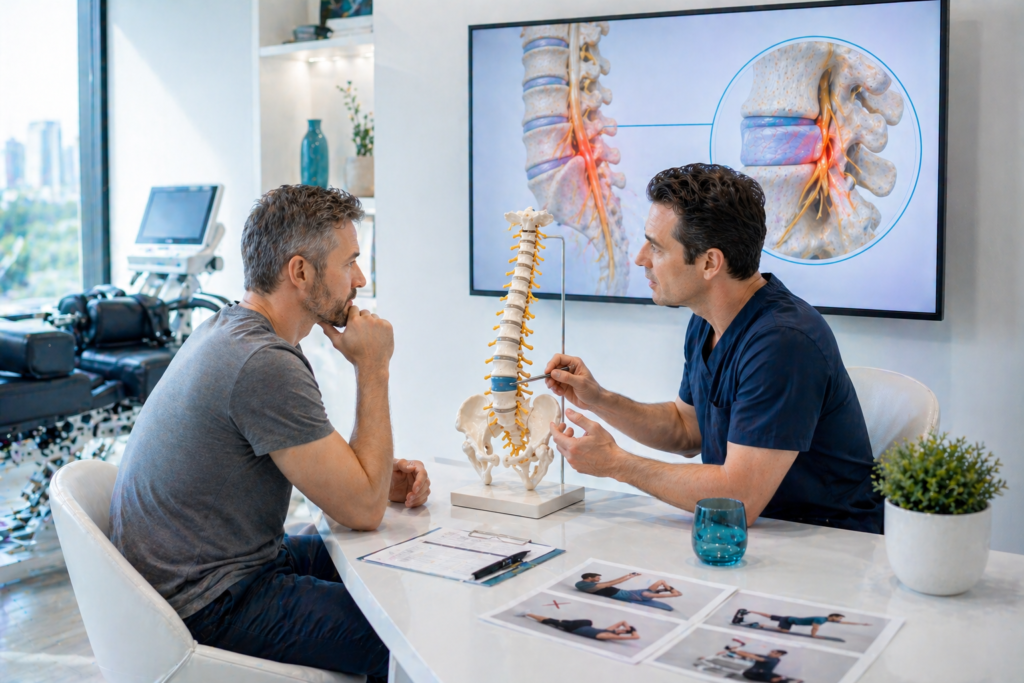
Local access
Serving Montreal and Nearby Communities
Because decompression care may require repeated visits, this page is intended for patients who can realistically attend in-person care at the Montreal / Mont-Royal clinic.
- Montreal
- Mont-Royal
- Outremont
- Côte-des-Neiges
- NDG
- Westmount
- Saint-Laurent
- Ahuntsic
- Villeray
- Rosemont
- Laval
- Longueuil
- Brossard
- West Island
Safety first
When Herniated Disc Symptoms Require Urgent Medical Attention
Most herniated disc cases are not emergencies, but some symptoms require immediate medical evaluation.
- Loss of bladder or bowel control
- Saddle numbness in the groin or inner thighs
- Rapidly worsening leg weakness
- Progressive foot drop
- Sudden severe weakness in both legs
- Fever with severe spinal pain
- Major trauma
- History of cancer with new severe spinal pain
Urgent care warning
If you experience bladder or bowel changes, saddle numbness, rapidly worsening weakness, or severe progressive neurological symptoms, seek urgent medical evaluation immediately.
Patient questions
Frequently Asked Questions About Herniated Disc Care After Failed Exercise-Based Treatment
Why did my herniated disc get worse after exercises?
Exercises may worsen symptoms if they increase compression, flexion, bracing, or nerve tension before the disc and nerve are ready for that load.
Does this mean exercise is bad for a herniated disc?
No. Exercise may be useful later in recovery. The issue is timing, tissue tolerance, and whether the disc is still mechanically reactive.
Can spinal decompression help after failed exercise-based care?
Spinal decompression may be appropriate for selected patients when symptoms suggest disc pressure or nerve irritation. A disc-focused evaluation is needed first.
What if stretching gives relief but pain returns later?
Temporary relief does not always mean the stretch is helping the disc. If pain returns later or sciatica worsens, the stretch may have irritated the nerve or exceeded tissue tolerance.
Do I need an MRI before booking?
An MRI can be helpful, but it is not always required before the first evaluation. If you already have imaging reports, bring them to your appointment.
Is this covered by RAMQ?
No. TAGMED services are private and are not covered by RAMQ. Receipts are issued for osteopathy and may be reimbursable by many private insurance plans, depending on your coverage.
Related resources