

Clinique TAGMED Terrebonne
Herniated Disc Treatment in Terrebonne
Disc-focused, non-surgical care for selected North Shore patients with persistent back pain, sciatica, leg pain, numbness, or tingling.
If you live in Terrebonne, Mascouche, Repentigny, Laval, Blainville, Boisbriand, Sainte-Thérèse, Rosemère, Lorraine, Bois-des-Filion, Saint-Eustache, Saint-Jérôme, Charlemagne, L’Assomption, Anjou, Montréal-Nord, or nearby areas, and your herniated disc symptoms have not improved with previous care, a disc-focused evaluation may help determine whether a decompression-first approach is appropriate.
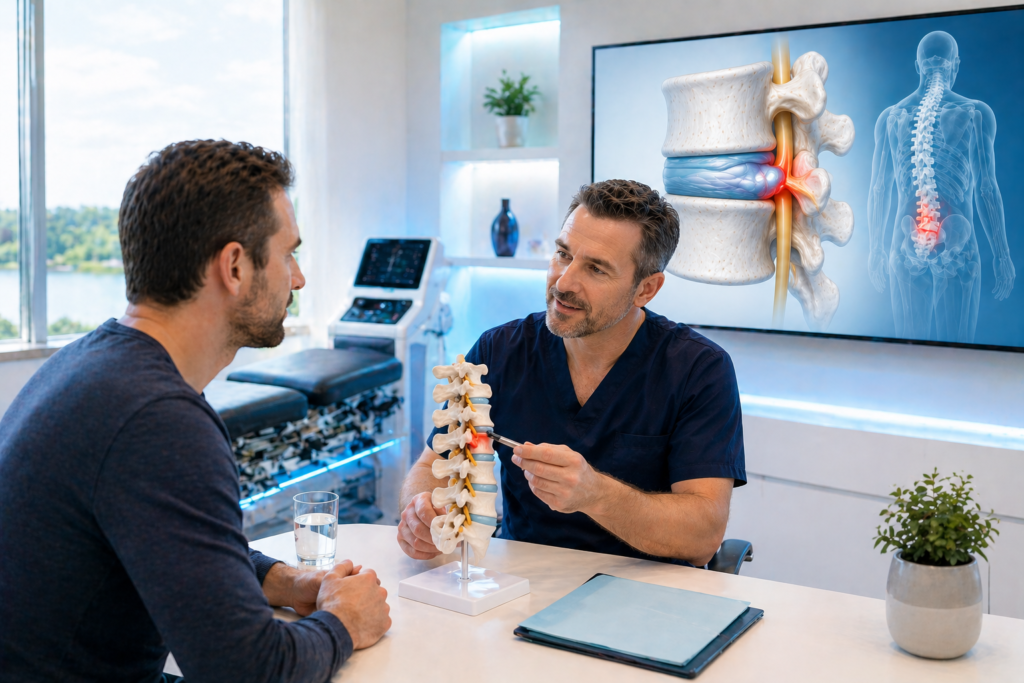
A local option for persistent disc symptoms
When a herniated disc does not respond to standard advice, the missing issue may be mechanical pressure.
Many patients with herniated disc symptoms are told to stretch, strengthen, stay active, or wait. For some back problems, this can be reasonable. But when pain travels into the leg, sitting becomes difficult, or sciatica keeps flaring after exercise, the disc may still be too irritated to tolerate loading.
At Clinique TAGMED Terrebonne, Dr. Sylvain Desforges evaluates selected patients with suspected or confirmed herniated disc symptoms to determine whether spinal decompression and other non-surgical TAGMED technologies may be appropriate as part of a personalized plan.
The goal is not to force rapid movement or promise a cure. The goal is to understand whether the injured disc first needs to be unloaded, calmed, and stabilized before progressive movement becomes safer.
Understanding the condition
A Herniated Disc Is Not Just a “Bad Back”
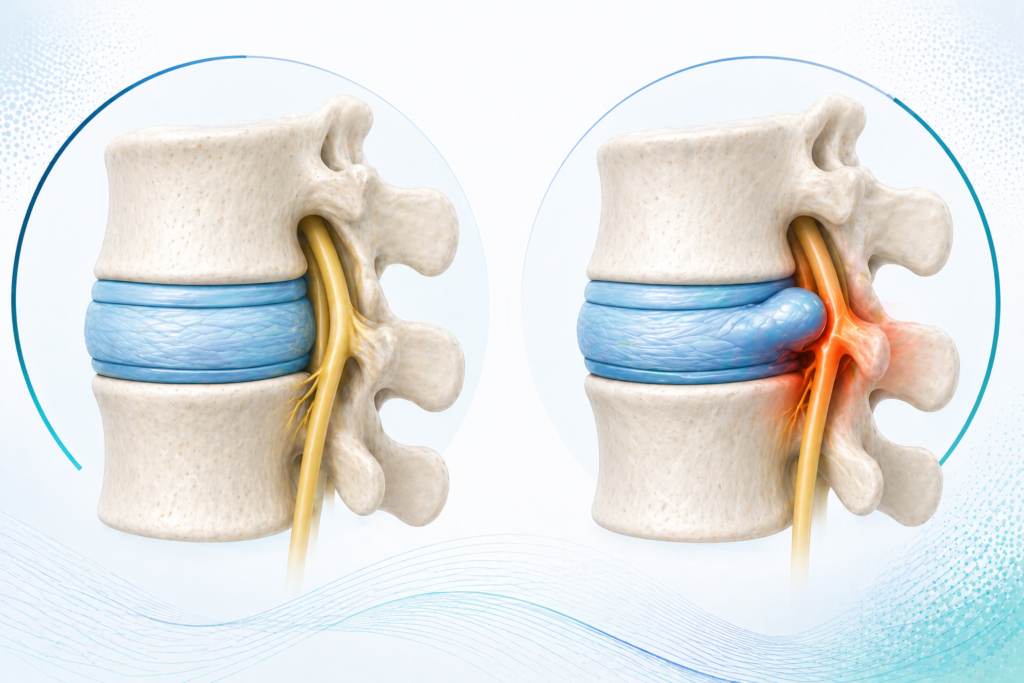
A herniated disc can behave differently from a simple muscle strain because it involves a pressure-sensitive structure near sensitive nerve tissue.
The disc can become pressure-sensitive
The spinal disc is designed to absorb force. When the outer ring is weakened or torn, pressure changes may push disc material toward the irritated area.
The nerve root may react
When a herniated disc irritates a nerve root, symptoms may travel into the buttock, leg, calf, foot, shoulder, arm, or hand depending on the level involved.
Repeated flare-ups matter
If sitting, stretching, bending, or exercise keeps triggering symptoms later in the day, the disc and nerve may still be mechanically reactive.
Common symptom patterns
Symptoms That May Suggest a Herniated Disc
Symptoms depend on the location of the disc, the direction of the herniation, and whether nerve irritation is present.
- Lower back pain with buttock or leg pain
- Sciatica traveling into the thigh, calf, or foot
- Numbness, tingling, burning, or electric-like symptoms
- Pain that worsens with prolonged sitting or driving
- Pain that flares after stretching, bending, or lifting
- Back spasms or protective muscle guarding
- Symptoms that worsen after core exercises or gym routines
- Pain that feels acceptable during activity but worsens later
- Difficulty walking, sleeping, working, or standing comfortably
- Persistent symptoms after previous conservative care
A symptom pattern does not automatically mean that decompression is appropriate. The evaluation helps determine whether your condition appears compatible with a pressure-reduction strategy.
TAGMED clinical approach
Why “Space First, Movement Later” May Matter
When a disc is irritated, loading it too early may restart the flare-up cycle. A more logical strategy for selected patients may be to reduce mechanical stress before rebuilding movement and strength.
“Before a pressure-sensitive disc is progressively loaded, it may first need to be calmed, unloaded, and evaluated.”
1
Identify the mechanical pattern
We evaluate whether symptoms behave like a disc-pressure pattern, nerve irritation pattern, or another spinal presentation.
2
Reduce provocative stress
When appropriate, care may focus on reducing compression, repeated flexion, twisting, prolonged sitting stress, or other aggravating patterns.
3
Progress safely
Strengthening and movement may be reintroduced later, once symptom behavior suggests improved mechanical tolerance.
Pressure-reduction strategy
How Spinal Decompression May Fit Herniated Disc Care
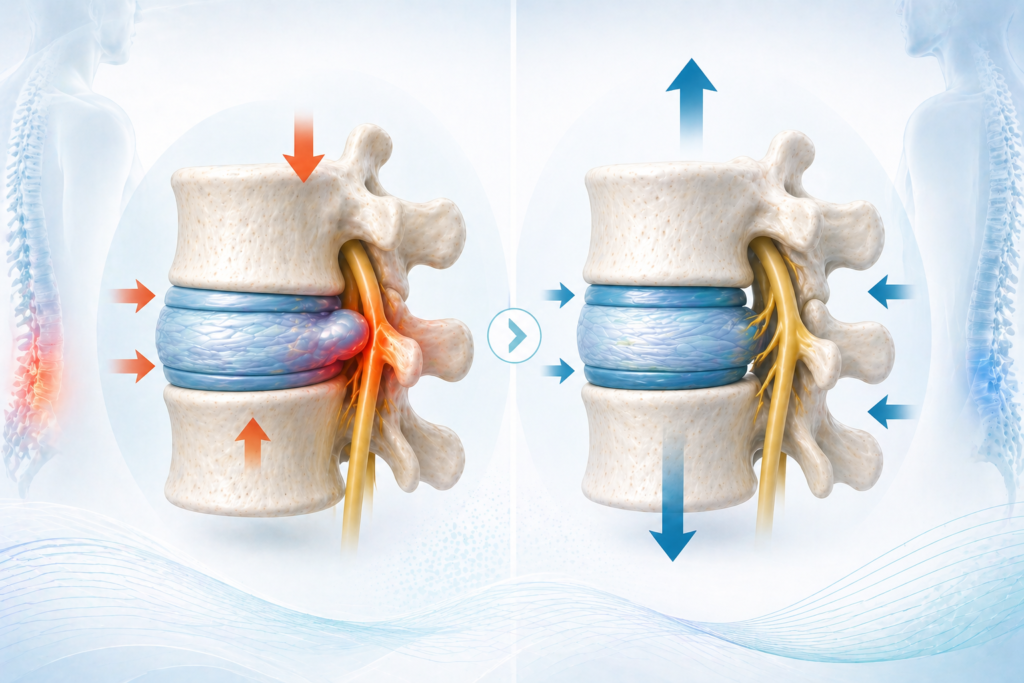
Spinal decompression is designed to gently unload selected spinal segments using controlled traction. It may be considered when the clinical evaluation suggests that disc pressure and nerve irritation are contributing to symptoms.
Reduce mechanical pressure
The goal is to decrease mechanical stress around an irritated disc and nerve root, not to force the spine into aggressive movement.
Support a calmer environment
When pressure is reduced, selected patients may tolerate daily activity more comfortably as the irritated tissues become less reactive.
Prepare for later movement
Decompression may be part of a sequence that later includes safer mobility, stabilization, and progressive loading when appropriate.
When previous care did not hold
Why Some Herniated Disc Patients Do Not Improve with Standard Exercise Advice
Many patients blame themselves when exercises do not work. In disc-related pain, the issue may not be motivation. It may be that the disc is not ready for compression, bracing, stretching, or load.
Stretching may irritate the nerve
A stretch may feel helpful at first but still increase nerve tension or disc stress, leading to symptoms later.
Core work may compress too early
Bracing and abdominal contraction may create pressure across the injured segment before the disc is ready.
Daily life may keep the disc reactive
Sitting, driving, bending, laundry, shoveling, vacuuming, and lifting may repeatedly reproduce the same mechanical stress.
Delayed flare-ups are important clues
If symptoms worsen two to four hours later or the next morning, the movement may have exceeded tissue tolerance.
Technology-based care when appropriate
TAGMED Services That May Be Considered
Depending on the evaluation, selected patients may be considered for one or more non-surgical, non-invasive TAGMED services.
Spinal decompression
Controlled unloading designed to reduce mechanical pressure on selected spinal segments.
Specific osteopathy
Precise biomechanical care adapted to the patient’s presentation and tolerance.
Class IV medical laser
May be considered when clinically appropriate to support pain and inflammation management.
Precision percussion
Instrument-assisted treatment may be used selectively as part of a personalized plan.
Conditions commonly evaluated
Disc-Related Conditions We Commonly Evaluate in Terrebonne
Patients commonly seek care for disc-related symptoms that interfere with sitting, walking, sleeping, work, driving, and daily function.
- Lumbar herniated disc
- L4-L5 herniated disc
- L5-S1 herniated disc
- Cervical herniated disc
- Disc protrusion
- Bulging disc
- Sciatica
- Radiating leg pain
- Numbness and tingling
- Disc-related low back pain
Local access
Serving Terrebonne and Nearby North Shore Communities
Because decompression care may require repeated visits over several weeks, this page is intended for patients who can realistically attend care at the Terrebonne clinic.
Terrebonne and Mascouche
Convenient access for patients close to the clinic who need repeated in-person care.
Repentigny and L’Assomption
Patients with persistent sciatica or disc symptoms may consider an evaluation in Terrebonne.
Laval, Blainville and nearby areas
Patients can choose Terrebonne when it is the most realistic location for repeated treatment visits.
- Terrebonne
- Mascouche
- Repentigny
- Laval
- Blainville
- Boisbriand
- Sainte-Thérèse
- Rosemère
- Lorraine
- Bois-des-Filion
- Saint-Eustache
- Saint-Jérôme
- Charlemagne
- L’Assomption
- Anjou
- Montréal-Nord
- Rivière-des-Prairies
What to expect
How a Disc-Focused Evaluation Works
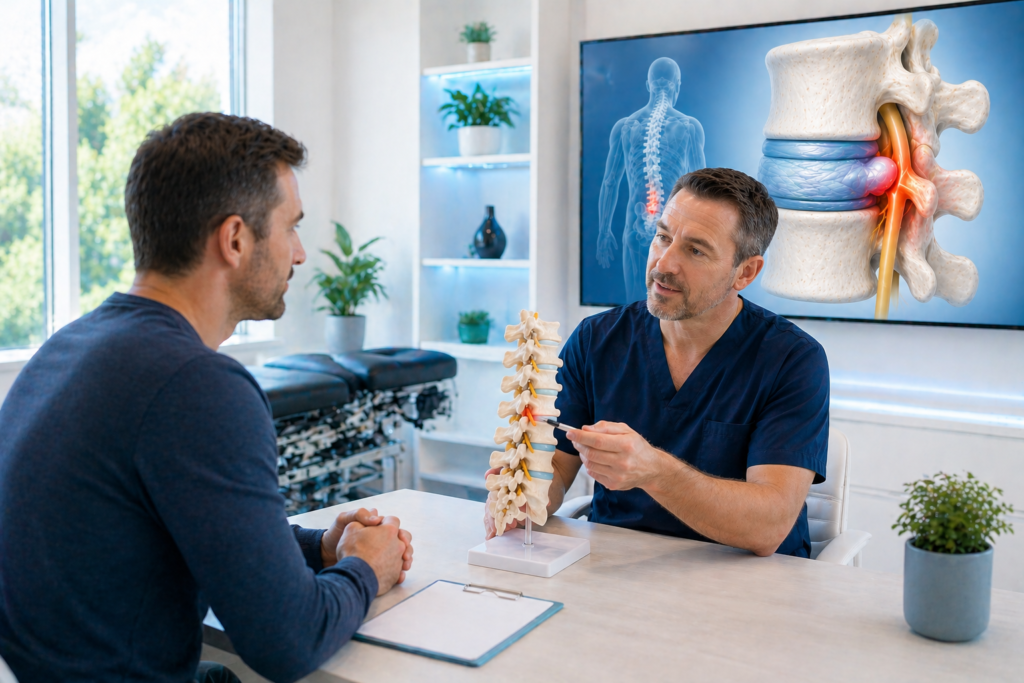
The evaluation helps determine whether your symptoms appear compatible with a decompression-based strategy and whether any safety concerns are present.
1
Symptom history
We review your pain pattern, previous care, daily limitations, and what makes symptoms better or worse.
2
Clinical assessment
We assess movement tolerance, nerve irritation signs, postural triggers, and mechanical sensitivity.
3
Imaging review
If you already have MRI or other imaging reports, bring them to your appointment for review.
4
Personalized plan
If appropriate, a decompression-focused plan may be recommended based on your presentation and tolerance.
Safety first
When Herniated Disc Symptoms Require Urgent Medical Attention
Most herniated disc cases are not emergencies, but some symptoms require immediate medical evaluation.
- Loss of bladder or bowel control
- Saddle numbness in the groin or inner thighs
- Rapidly worsening leg weakness
- Progressive foot drop
- Sudden severe weakness in both legs
- Fever with severe spinal pain
- Major trauma
- History of cancer with new severe spinal pain
Urgent care warning
If you experience bladder or bowel changes, saddle numbness, rapidly worsening weakness, or severe progressive neurological symptoms, seek urgent medical evaluation immediately.
Patient questions
Frequently Asked Questions About Herniated Disc Treatment in Terrebonne
Is herniated disc treatment available at the Terrebonne clinic?
Yes. Clinique TAGMED Terrebonne evaluates selected patients with herniated disc symptoms, sciatica, radiating pain, numbness, tingling, and pressure-sensitive spinal pain.
Can spinal decompression help a herniated disc?
Spinal decompression may be appropriate for selected patients with disc-related symptoms. A disc-focused evaluation is needed to determine whether your condition fits this type of mechanical approach.
What if exercises made my symptoms worse?
If stretching or strengthening repeatedly worsens your symptoms, the disc may still be mechanically reactive. A decompression-first evaluation may help determine whether loading was introduced too early.
Do I need an MRI before booking?
An MRI can be helpful, but it is not always required before the first evaluation. If you already have imaging reports, bring them to your appointment.
How often would I need to come for decompression care?
Spinal decompression protocols often require repeated visits over several weeks. This is why patients should live within realistic driving distance of the Terrebonne clinic.
Is this covered by RAMQ?
No. TAGMED services are private and are not covered by RAMQ. Receipts are issued for osteopathy and may be reimbursable by many private insurance plans, depending on your coverage.
Related resources