Neck Surgery in Montreal: Modern and Effective Solutions
October 26, 2025
Minimally Invasive Surgery in Longueuil: Advanced Spine Techniques
October 26, 2025
Low back pain remains one of the most pervasive and disabling conditions worldwide, impacting millions of people’s quality of life and productivity. Amid a landscape of evolving treatments, the IntraSPINE device has emerged as a promising minimally invasive surgical option in Laval, Canada, offering long-term relief for patients with lumbar degenerative disc disease and chronic low back pain. Drawing upon a unique interlaminar placement, this innovative implant supports natural spinal motion and biomechanical balance, distinguishing itself from traditional fusion or simple decompression surgeries.
The management of chronic low back pain requires both scientific rigor and patient-centered care. With over 30 years of experience in spinal health evaluation, expertise in advanced conservative therapies such as neuroverbal decompression at clinics like Clinique TAGMED, and a commitment to evidence-based practice, this treatment modality aligns with modern standards of safety and effectiveness. Laval’s access to IntraSPINE represents a coordinated transatlantic healthcare innovation, bringing together Canadian patients and leading French spinal surgery specialists.
In this detailed exploration, we discuss the biomechanics and clinical benefits of IntraSPINE, the stages of the patient journey from assessment to recovery, and the value of combining advanced conservative care with surgical innovation. Patients considering surgical alternatives to lengthy wait times or costly options in Quebec will find practical insights and encouragement to engage fully in their treatment decisions.
How IntraSPINE Revolutionizes Long-Term Management of Lumbar Degenerative Disc Disease
IntraSPINE introduces a paradigm shift in lumbar spine surgery by focusing on motion preservation rather than fusion or rigid stabilization. Unlike posterior interspinous devices, which are positioned more dorsally and may impede natural movement, IntraSPINE is placed in the interlaminar space, near the physiological center of rotation of each spinal segment.
This anatomical positioning provides multiple mechanical advantages: first, a rocking movement pattern during flexion and extension mimics natural spinal motion, reducing the stress on adjacent structures; second, it offloads facet joints in extension without completely blocking movement; third, it acts as a fulcrum to limit excessive flexion combined with the intact posterior ligament complex, thereby protecting the degenerative disc from further damage.
Several clinical studies, including a prospective three-year investigation, have demonstrated significant improvements in functional disability and pain scores among patients treated with IntraSPINE. For instance, patients reported an average 64.5% improvement in Oswestry Disability Index scores and reductions exceeding 40% in low back and radicular pain on visual analog scales. These clinical gains were complemented by high satisfaction rates and a substantial return-to-work rate within months post-surgery, underscoring not only the efficacy but also the socioeconomic benefits of this approach.
Biomechanical Features of IntraSPINE That Enhance Patient Outcomes
- Dynamic Stabilization: Provides targeted support without rigid fixation.
- Preserves Segmental Mobility: Maintains near-normal spine mechanics.
- Facet Joint Offloading: Reduces excess compressive forces during extension.
- Controls Flexion: Limits harmful over-bending through a natural lever.
- Material Composition: Silicone core with polyethylene terephthalate outer shell, preventing adhesions and allowing soft tissue integration.
| Parameter | Preoperative | 36 Months Postoperative | Improvement (%) |
|---|---|---|---|
| Oswestry Disability Index (ODI) | 44.8 | 15.9 | 64.5% |
| Low Back Pain VAS Score | 59.8 | 32.1 | 46.4% |
| Radicular Pain VAS Score | 52.3 | 17.7 | 66.2% |
The IntraSPINE device’s patented design and CE marking speak to its regulatory rigor and clinical validation in Europe, with expanding availability in Canada through specialized partnerships.
IntraSPINE® in Sherbrooke: Durable Solution for Chronic Low Back Pain
The management of chronic low back pain, a widespread condition affecting millions across Quebec and beyond, has reached a pivotal moment thanks to innovative medical technologies and coordinated care pathways. At the heart of this evolution lies the IntraSPINE implant,…
The Multi-Stage Patient Journey for IntraSPINE Surgery in Laval: Expertise and Coordination Across Borders
Embarking on spine surgery requires an informed and carefully coordinated pathway. Dr. Sylvain Desforges, with his 30+ years’ experience and leadership roles in osteopathy and spinal care organizations, ensures a rigorous evaluation process that aligns with Canadian medical standards and optimizes surgical readiness.
The patient journey includes several critical stages:
- Comprehensive Clinical Evaluation: Detailed assessment of back pain etiology, prior conservative treatments, and spine imaging reviewed by Dr. Desforges and associated multidisciplinary teams.
- Conservative Care Optimization: Prior to surgical consideration, at least 3 to 6 months of conservative treatments including physical therapy, manual osteopathy, and advanced neurovertebral decompression at centers like Clinique TAGMED are recommended.
- Specialized Surgical Consultation: Collaboration with French surgeons experienced in IntraSPINE implantation, ensuring patient-specific surgical planning and implant sizing based on imaging.
- Surgery and Immediate Postoperative Care: Performed at accredited clinics in Laval or partner institutions in France, leveraging minimally invasive techniques to reduce hospital stay and complications.
- Return and Rehabilitation Coordination: Seamless handoff to Canadian care providers with structured rehabilitation protocols and follow-ups assisted by Dr. Desforges’ coordination efforts.
This transatlantic pathway combines expertise and streamlines wait times, providing patients personalized care that blends precision medicine with evidence-based innovation.
| Stage | Typical Timeframe | Key Activities |
|---|---|---|
| Evaluation & Conservative Care | 3-6 months | Assess diagnosis, optimize non-surgical therapies including neurovertébral decompression |
| Surgical Planning | 2-4 weeks | Imaging review, implant selection, pre-operative preparations |
| Surgery & Hospital Stay | 1-3 days | Minimally invasive implantation, immediate post-op monitoring |
| Rehabilitation & Follow-up | 6 weeks to 6 months | Guided physiotherapy, pain management, long-term outcome monitoring |
Through ties with organizations such as Medtronic, Stryker, and NuVasive, the surgical teams utilize globally recognized implant technologies that ensure premier quality and reliability.
Spine Surgery in Trois-Rivières: Reduce Pain and Preserve Mobility
In recent years, spine surgery in Trois-Rivières has evolved notably, combining advanced medical expertise with innovative technologies to deliver patient-centered care. This growing field addresses the increasing demand among Quebec residents seeking effective solutions for chronic back pain and mobility…
Decoding Surgical Options in France: Simple, Fusion, and Motion-Preserving Surgeries Compared
Patients exploring spine surgery often face a complex array of surgical choices. Understanding the differences among these options empowers clear decision-making.
Here are three principal types of lumbar spine surgery available in France, often accessible via the transatlantic partnership led by healthcare coordinators like Dr. Desforges:
- Simple Decompression Surgery: Focuses on relieving nerve compression by removing bone or disc material without adding fixation. This approach can be effective for spinal stenosis or disc herniation causing radicular pain but may not address instability or degenerative progression fully.
- Fusion Surgery: Involves stabilizing one or more vertebral segments by mechanically fusing them with bone grafts and often instrumentation from recognized companies such as Boston Scientific, Zimmer Biomet, or DePuy Synthes. Fusion reduces segmental motion but may increase stress on adjacent segments.
- Motion-Preserving Surgery: Includes technologies like total disc arthroplasty and dynamic stabilization devices such as IntraSPINE or TOPS. These preserve segmental motion, aiming to maintain biomechanics closer to natural function, potentially reducing adjacent segment degeneration risks.
| Surgical Type | Indications | Advantages | Limitations |
|---|---|---|---|
| Simple Decompression | Spinal stenosis, disc herniation causing nerve root compression | Minimally invasive, immediate symptom relief | Does not stabilize segment; risk of instability |
| Fusion | Instability, spondylolisthesis, degenerative disc disease with pain | Effective stabilization, prevention of further degeneration at affected segment | Loss of segment motion, adjacent segment disease risk |
| Motion-Preserving | Degenerative disc disease, early instability; chronic low back pain | Maintains mobility, reduces adjacent segment stress | Implant durability concerns, need for careful patient selection |
Patients benefit from an individualized approach where expert evaluation determines the best match, often after advanced trials of conservative treatments for at least 3 to 6 months. This strategy aligns precisely with the ethical, scientific, and patient-focused care championed by Dr. Desforges.

TOPS™ in Gatineau: High-Performance Option for the Lumbar Spine
The landscape of spinal surgery has witnessed profound evolution, particularly for patients grappling with lumbar spine disorders such as spinal stenosis and spondylolisthesis. These conditions, increasingly prevalent among Quebec’s population, impose substantial limitations on mobility and quality of life. The…
Combining Conservative Care with Surgical Innovation: The Essential Waiting Period Before Considering Surgery
One of the foundational principles in managing lumbar spine complaints is that surgery is never the first line of treatment. Instead, it should only be contemplated following a thorough course of conservative therapies lasting between three and six months.
This timeframe enables natural healing of tissues where possible, pain management through non-invasive means, and assessment of surgical necessity based on persistent symptoms. It’s particularly important that these conservative measures include advanced options like neurovertebral decompression therapy available at Clinique TAGMED, which uses state-of-the-art technology backed by recent clinical evidence to relieve nerve root compression and disc pathology.
If symptoms improve during this period, patients may avoid surgery altogether or proceed with milder interventions.
- Physical therapy: Specialized therapeutic exercises targeting core stability and spinal alignment.
- Manual osteopathic treatment: Skilled interventions optimizing musculoskeletal health.
- Neurovertebral decompression: Non-surgical method reducing intradiscal pressure, proven in multiple studies (research reference).
- Pharmacological pain management: Medication guided by evidence-based protocols including selective use of SNRIs or non-opioid analgesics.
- Behavioral therapies: Acceptance and commitment therapy (ACT), mindfulness, and self-management programs approved for chronic low back pain care.
At the conclusion of this conservative phase, a thorough reassessment by Dr. Desforges and his team determines if surgical intervention is warranted based on symptom persistence, imaging findings, and individual patient goals.

Cervical Disc Prosthesis in Quebec City: Avoid Post-Surgery Stiffness
Chronic neck pain remains a significant challenge for thousands of residents in Quebec City every year, often leading them to seek effective spinal surgery options that minimize downtime and maximize long-term mobility. Among the recent advancements revolutionizing cervical spine care,…
Why Opt for a Transatlantic Surgical Care Plan? Advantages Beyond Borders
The partnership linking Canadian patients with leading surgical institutions in France presents several compelling advantages:
- Reduced Wait Times: Access to timely surgery avoids prolonged disability commonly encountered in public healthcare waitlists in Quebec.
- Cost Efficiency: Competitive pricing of surgical procedures in France combined with coordinated insurance facilitation reduces out-of-pocket expenses.
- Access to Advanced Technology: The French clinical centers offer innovative implants like IntraSPINE approved in Canada but more widely adopted in Europe. Collaboration with companies such as Orthofix, Alphatec Spine, and SpineWave ensures cutting-edge implant technology.
- Personalized Multidisciplinary Support: Multistem professional teams including surgeons, osteopaths, and rehabilitation specialists provide integrated care, which is coordinated by Dr. Desforges for seamless transition back to Canada.
- Scientific Excellence and Innovation: The collaborating centers maintain strict ethical and scientific standards with continuous outcome monitoring and use of evidence-based protocols.
| Advantage | Details | Benefit to Patient |
|---|---|---|
| Timely Access | Shorter surgery scheduling in France | Faster pain relief, quicker return to work |
| Cost Effectiveness | Lower overall procedure and rehab costs | Less financial burden for families |
| Technological Edge | Utilization of latest implants from top manufacturers | Improved surgical outcomes, less invasive surgeries |
| Continuity of Care | Coordinated follow-up post-return | Better recovery adherence, reduced complications |
This international collaboration exemplifies patient-centered innovation and responsibility, balancing state-of-the-art technology with the empathy and rigour patients need on their spine care journey.
Minimally Invasive Surgery in Longueuil: Reduce Hospital Stay Duration
In recent years, advances in spinal care have dramatically reshaped the treatment landscape for patients suffering from debilitating spinal conditions. Particularly in Longueuil, the emergence of minimally invasive surgery (MIS) techniques offers a transformative alternative to conventional open surgeries. These…
Exploring the Role of Leading Spine Technology Companies in Modern Surgical Care
Companies such as Medtronic, Boston Scientific, Zimmer Biomet, Stryker, DePuy Synthes, Globus Medical, NuVasive, SpineWave, Orthofix, and Alphatec Spine drive innovation in spinal implants, instruments, and technologies.
Through research collaborations and surgical partnerships, they provide critical tools and devices that support procedures including those with IntraSPINE technology. Their continuous development helps improve surgical precision, reduce invasiveness, and enhance patient recovery experiences.
For patients navigating their options, awareness of these industry leaders allows informed discussions on the types of devices and surgical approaches best suited for their specific condition and lifestyle.
IntraSPINE® in Laval: Modern Solution for Lumbar Stabilization
In the evolving landscape of orthopedic treatments, the city of Laval has become a hub for innovations addressing chronic lower back pain. Among the groundbreaking solutions gaining attention is the IntraSPINE device—a modern spinal implant designed to offer dynamic lumbar…
Pondering Patient Education and Engagement in Chronic Low Back Pain Treatment
A cornerstone of outstanding spine care is clear and empathetic communication. Dr. Sylvain Desforges prioritizes patient education, demystifying complex biomechanical and surgical concepts to empower individuals in their treatment decisions. Through detailed discussions of pros and cons, expected outcomes, and recovery milestones, patients gain confidence to actively participate in their care.
Practical patient engagement strategies include:
- Simplified Explanation of Spine Pathologies and Treatments: Avoiding excessive jargon while using clear analogies and visuals.
- Discussion of Treatment Alternatives and Sequencing: Highlighting when surgery is or isn’t needed after conservative care.
- Shared Decision-Making Tools: Providing personalized risk-benefit profiles based on patient phenotype and lifestyle.
- Post-Operative Guidance and Support: Coordinated rehab plans with local providers reviewed regularly by Dr. Desforges.
This focus not only enhances patient satisfaction but also improves adherence and long-term outcomes.
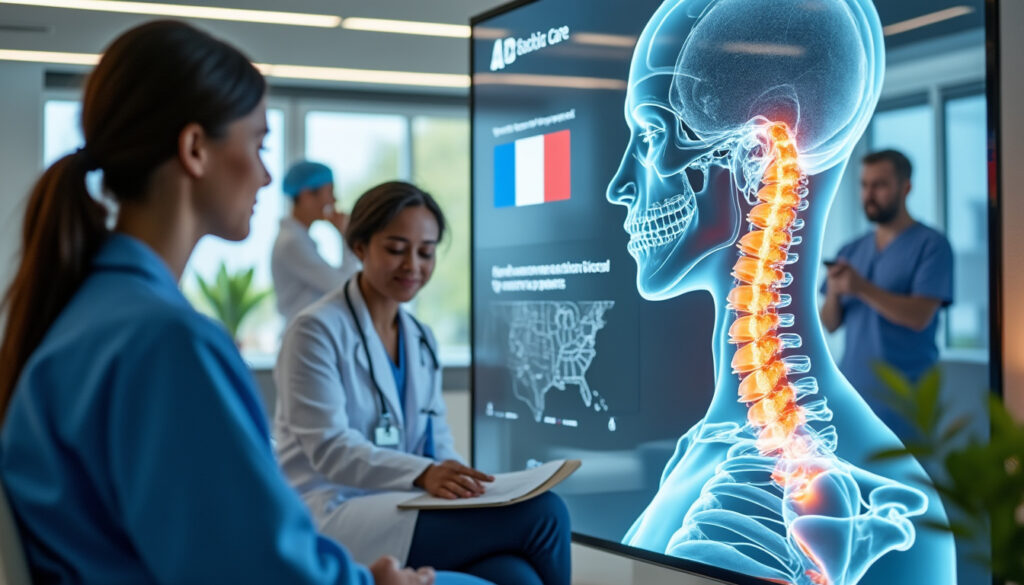
Neck Surgery in Montreal: Maintain Cervical Flexibility and Function
Neck conditions causing persistent pain or functional loss place a substantial burden on individuals and healthcare systems, especially in urban centers like Montreal. Surgical interventions targeting the cervical spine have evolved tremendously, aiming not only to relieve symptoms but to…
Patient-Centered Support Systems Before, During, and After IntraSPINE Surgery
Comprehensive spinal care extends beyond the operating room. Patients preparing for IntraSPINE surgery in Laval benefit from multidisciplinary teams that emphasize holistic support:
- Preoperative Counseling: Addressing anxiety, expectations, and detailed procedural walkthroughs.
- Multimodal Pain Management Plans: Combining pharmacologic and non-pharmacologic interventions.
- Personalized Rehabilitation: Tailored physical therapy matched to surgical specifics and patient goals.
- Continuous Monitoring: Regular clinical and imaging assessments to identify and manage potential complications early.
- Psychological Support: Access to behavioral therapies such as acceptance and commitment therapy (ACT) to assist coping and functional recovery.
These elements reflect a patient-first philosophy essential for sustainable improvement and wellbeing post-surgery.

Disc Prosthesis in Lévis: Quick and Long-Lasting Results
Chronic back pain caused by degenerative disc disease continues to profoundly impact the quality of life for many residents in Lévis and the broader Quebec area. For decades, traditional spinal fusion surgery has been the primary solution for alleviating severe…
Staying Informed and Taking Action: Next Steps for Patients Considering IntraSPINE in Quebec
The path to alleviating chronic low back pain with innovative treatments like IntraSPINE starts with an expert evaluation. Patients in Quebec or across Canada are invited to start their individualized care journey by consulting with Dr. Sylvain Desforges.
Through rigorous assessment aligned with provincial and federal regulations and personalized care pathways integrating conservative treatments as recommended at Clinique TAGMED, patients gain access to tailored recommendations for surgical or non-surgical care. This includes coordination for possible transatlantic surgery in partnership with top French clinics, ensuring safety, personalization, and cutting-edge biomechanical technology.
To explore options and receive expert guidance, patients can connect with the clinical team to request a detailed evaluation. Active participation and informed decision making are encouraged every step of the way.
What types of patients are candidates for IntraSPINE surgery?
Patients with lumbar degenerative disc disease who have failed at least 3-6 months of conservative treatment including physical therapy and neurovertebral decompression are potential candidates. The decision involves multidisciplinary evaluation.
How does IntraSPINE differ from traditional spinal fusion?
Unlike fusion, IntraSPINE preserves segmental motion by acting as a dynamic stabilizer that offloads facet joints but allows natural flexion and extension, potentially reducing adjacent segment degeneration.
What should patients expect during recovery after IntraSPINE placement?
Most patients experience significant pain reduction and improved function within weeks. Rehabilitation involves tailored physiotherapy and regular follow-up. Return to work rates are high, often within three months.
Is the IntraSPINE implant approved in Canada?
Yes, IntraSPINE is CE marked and is gaining regulatory acceptance in Canada, available through specialized centers coordinating transatlantic care pathways.
Are there alternatives to surgery?
Yes. Innovations in conservative care, such as those provided by the Clinique TAGMED, include neurovertebral decompression, advanced manual therapies, and behavioral programs, which should be explored before considering surgery.