
IntraSPINE® in Laval: Accelerated Recovery for Active Patients
June 27, 2026
Comprehensive Guide to Simple Surgery, Fusion Techniques, and Motion Preservation
June 27, 2026
Quebec’s healthcare system is navigating a complex landscape marked by increasing surgical wait times and a pressing need for optimized patient care pathways. Amidst the challenge of surgical backlogs, particularly in spinal surgery, Quebec has been pioneering medical guidance strategies that emphasize conservative treatments and streamlined patient management. This innovative approach offers hope to many Quebecers seeking to avoid surgery through non-invasive alternatives and well-coordinated medical consultation. By leveraging international collaborations, advanced neurophysiological assessments, and robust patient support programs, the province is reshaping how spinal and other complex conditions are managed to optimize outcomes and reduce unnecessary surgical interventions.
The expansion of privately performed surgeries at no cost in Quebec has opened new avenues to alleviate waitlists, yet the demand continues to outpace supply, prompting the healthcare community to rethink surgical prevention through enhanced medical advice and healthcare alternatives. Collaborative efforts between Quebec and European medical centers, particularly in France, provide a compelling model of integrated patient care that incorporates preoperative neurotherapy and post-surgical follow-up designed to maximize recovery and in some cases, preclude the need for surgery altogether.
Understanding the Quebec Healthcare Landscape and Surgical Backlogs
In recent years, Quebec has witnessed an unprecedented rise in the number of patients waiting for surgery, a trend exacerbated by the global pandemic’s impact on healthcare delivery. According to recent data, over 170,000 individuals are currently on surgical waitlists, marking a record high for the province. This situation places immense pressure on healthcare providers and patients alike, emphasizing the urgency of finding preventative strategies within the Québec healthcare framework.
This backlog is particularly pronounced in spinal and orthopedic surgeries, areas where patient quality of life can deteriorate rapidly without timely intervention. Quebec’s public health system has responded by expanding the types of surgeries available privately and for free, as detailed in reports that indicate the inclusion of approximately 20 new surgical services beyond traditional cataracts, knee, and hip procedures. This broadening effort, covered extensively by local news outlets, aims to leverage private clinics to deliver timely care while maintaining universal access under the public system.
Nevertheless, many patients face the dilemma of waiting extended periods or opting for alternative pathways to manage their conditions. Quebec’s medical guidance framework seeks to address this challenge by fostering a more comprehensive patient care approach that prioritizes non-surgical treatment plans when feasible, supported by meticulous medical consultation.


Understanding Sciatic Pain: Key Symptoms and When to Seek Medical Advice
Sciatic pain is a prevalent condition impacting a wide demographic, manifesting primarily as intense pain radiating from the lower back down the leg. This pain stems from irritation or compression of the sciatic nerve, a major nerve extending through the…
Comprehensive Medical Evaluations as a Gateway to Surgical Prevention
Central to avoiding unnecessary surgery is the principle of thorough and multidisciplinary medical evaluation, an approach deeply embedded in Quebec’s patient care philosophy. Before venturing into surgical options, patients are subjected to extensive neurophysiological assessments and detailed clinical evaluations designed to understand the full scope of their spinal pathologies.
These evaluations, often conducted at specialized centers like TAGMED and overseen by expert teams, incorporate advanced diagnostic questionnaires, mobility assessment, and imaging review to delineate symptom severity and daily life impact. For instance, patients with lumbar spinal stenosis undergo multifaceted analysis that includes computerized neurovertebral decompression techniques — a conservative treatment modality seeking to relieve symptoms without immediate recourse to surgery.
A unique aspect of Quebec’s medical guidance is the integration of patient dialogue at this stage. The medical team invests in educating patients about their condition, surgical options, and importantly, the conservative alternatives available. This patient-centered communication enhances informed decision-making and supports the psychological wellbeing necessary to explore healthcare alternatives effectively.
In helping patients navigate this complex decision matrix, Quebec’s approach draws heavily on surgical prevention principles and the augmentation of non-surgical treatment plans, thereby minimizing the number of cases proceeding directly to invasive procedures. The practice is closely aligned with the guidance outlined by the Canadian Medical Protective Association, which underscores the importance of consent and detailed medical consultation before any invasive intervention.
List of Core Evaluation Components in Quebec’s Pre-Surgical Pathway
- Comprehensive symptom and medical history review
- Neurological and neurophysiological testing
- Advanced imaging studies including MRI and CT scans
- Assessment of physical function and pain impact through validated questionnaires
- Participation in non-surgical interventions such as computerized decompression therapy
- Patient education about risks, benefits, and alternatives to surgery

The Stepwise Role of Functional Recovery in Achieving Successful Outcomes
The journey to full recovery following spinal surgery is often complex and multifaceted, demanding a meticulously structured approach to ensure optimal functional outcomes. In recent years, the concept of functional recovery through a stepwise approach has garnered significant attention in…
Leveraging International Collaboration: Quebec and France’s Integrated Care Model
Faced with the challenge of prolonged wait times within its healthcare system, Quebec has embraced an innovative model of medical guidance by collaborating with specialized French surgical centers. This transatlantic partnership facilitates expedited access to advanced surgical technologies and methodologies that may not yet be widely available in Quebec, thanks to sophisticated referral coordination by companies such as Franchir.
One key figure in this process is Marcel Mazaltarim, whose expertise in neurotherapy supports patient evaluation and post-operative follow-up. His role is pivotal in ensuring the continuity of care through rigorous neurophysiological monitoring and personalized rehabilitation protocols, which extend well beyond the operating theater to the patient’s eventual return to Quebec. This thorough follow-up is integral to optimizing patient outcomes and limiting surgical necessity to cases with the clearest indication.
Patients sent to France encounter an orchestrated medical logistics workflow encompassing the selection of expert surgeons, accommodation near specialized centers, and tailored transfer arrangements—all managed to mitigate stress and improve healing conditions. This integrated approach serves as a blueprint for delivering healthcare alternatives and is supported by detailed guidance on medical logistics and accommodation, which enables patients to focus on recovery rather than administrative hurdles.


Transatlantic Patient Journey: Insights into Indications, Benefits, and Challenges
The emergence of the Transatlantic Patient Journey as a strategic model within healthcare continues to capture attention for its innovative potential, especially in specialized fields such as spinal surgery. This cross-border care pathway integrates rigorous medical evaluation from Quebec with…
Advances in Surgical Techniques in France Benefitting Quebec Patients
French surgical centers offer an impressive array of cutting-edge treatments that Quebec patients can access through this pathway. Notably, there is an emphasis on minimally invasive spine surgery, including endoscopic techniques that reduce tissue damage and promote faster recovery. These innovations include the use of dynamic implants such as TOPS and Intraspine devices, which maintain spinal mobility while providing needed stabilization—a departure from traditional fusion surgeries that restrict movement.
The benefits of these implants are considerable, including minimizing adjacent segment degeneration and enhancing postoperative quality of life by preserving spinal function. Such technologies are supported by a network of over twenty skilled French surgeons, offering Quebec patients both technical expertise and priority access previously unattainable locally due to capacity limitations.
Moreover, robotic-assisted surgery and 3D imaging platforms have been integrated into spinal procedures, greatly enhancing surgical precision and safety. These advancements align with global trends in robotic surgery, facilitating better clinical outcomes and fewer complications, as evidenced by up-to-date studies and institution reports in France.
| Technique / Implant | Main Indications | Advantages | Impact on Quality of Life |
|---|---|---|---|
| Arthrodesis (Fusion) | Spondylolisthesis, spine deformities, instability | Proven stability and durability, well-established outcomes | Effective pain reduction, but limits spinal movement |
| Cervical Disc Prosthesis | Disc herniation, cervical disc disease | Maintains neck mobility, accelerates recovery | Improves function, reduces risk of adjacent segment disease |
| TOPS Dynamic Stabilization | Lumbar stenosis, moderate instability | Preserves spinal motion, alternative to fusion | Improves range of motion, reduces pain |
| Endoscopic Spine Surgery | Herniated discs, nerve decompression | Minimally invasive, reduced scarring | Faster return to activity, less postoperative pain |
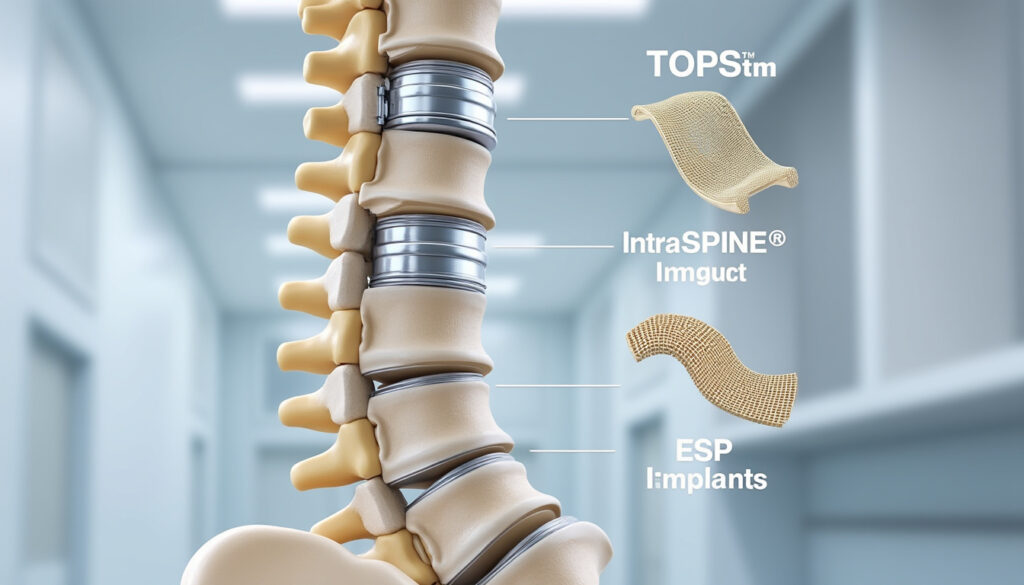
The evolving field of spinal surgery is witnessing a transformative shift, fueled by cutting-edge implant technologies such as TOPS, Intraspine, and ESP. These innovative implants redefine treatment possibilities by emphasizing preservation of natural spinal mechanics, while ensuring durable stabilization and…
Non-Surgical Treatment Options Supported by Quebec Medical Guidance
Beyond surgical strategies, Quebec’s medical guidance emphasizes a spectrum of conservative care options designed to manage spinal conditions effectively. These healthcare alternatives are integral to surgical prevention and include physical therapy, computerized neurovertebral decompression, and advanced modalities like biofeedback and neurofeedback. These technologies assist patients in modulating pain and enhancing neuromuscular control, contributing to improved function without surgery.
Evidence indicates that early adoption of personalized conservative treatment can delay, and occasionally, negate the need for surgery. The integrated care approach also prioritizes addressing psychological factors such as fear avoidance and illness perception, which significantly influence recovery trajectories. Medical advice thus extends beyond purely physical interventions, encompassing patient education and motivational interviewing.
Healthcare providers in Quebec actively collaborate with rehabilitation specialists and neurotherapists to tailor non-surgical plans aligned with individual patient profiles. This approach is supported by detailed insights published in specialized resources focusing on conservative treatments versus surgery, providing patients with up-to-date information to make informed choices.

Preparing for Surgery in France: Key Indications, Benefits, and Limitations
In an evolving global healthcare landscape, France emerges as a beacon of advanced surgical expertise, particularly attracting international patients seeking expedited and innovative medical interventions. Patients from regions experiencing long wait times, such as Quebec, increasingly view France as an…
The Critical Role of Patient Care Coordination and Medical Logistics
Coordinating patient care is fundamental to avoiding unnecessary surgeries and ensuring seamless treatment journeys, particularly when international travel for care is involved. Quebec’s model incorporates meticulous planning in medical logistics, including appointment scheduling, accommodation arrangements, transportation, and communication between the patient and medical teams across borders.
This coordination reduces stress and logistical barriers, enabling patients to focus entirely on recovery and compliance with therapy protocols. Services like SOS Tourisme Médical provide comprehensive support in managing the complex organization of medical stays abroad, which also integrates smoothly with Quebec healthcare services upon the patient’s return.
Effective patient care coordination includes:
- Pre-arrival assessment and eligibility verification by expert medical teams
- Secure booking of flights, hospitals, and hotels
- Customized transfers aligned with surgical schedules
- Ongoing communication between patient, international surgeons, and local caregivers
- Post-operative rehabilitation and neurophysiological follow-up in Quebec
Such comprehensive support is instrumental in surgical prevention, ensuring patients benefit from non-surgical treatments and receive optimal care without undue delay or complications.

Medical Treatments Comparison

Unveiling the Hidden Benefits of Quality and Certification in Devices
The landscape of device manufacturing and clinical application in 2026 has been fundamentally shaped by the rigorous interplay between quality management and certification processes. Within this complex framework, the hidden benefits of adhering to international standards and obtaining relevant certifications…
Continuous Post-Operative Support and Surgical Prevention Through Medical Guidance
An often overlooked but crucial stage in the patient care journey is post-operative management, which Quebec addresses through a holistic and patient-centered approach. Upon returning from surgery abroad, patients benefit from close monitoring and rehabilitation coordinated by specialized centers like Neurothérapie Montréal.
Post-operative follow-up integrates neurofunctional assessments and employs state-of-the-art technology such as neurofeedback to enhance neurological recovery and functional outcomes. This sustained care model ensures complications are promptly identified and managed, diminishing the risk of reoperation or prolonged disability.
Significantly, this stage also includes psychological support, pain management education, and gradual return to daily activities, all of which contribute to long-term surgical prevention. By embedding surgical prevention strategies throughout the patient care continuum, Quebec’s medical guidance promotes better health services and elevates patient quality of life.
Why Experts Advocate for Comprehensive Preoperative Evaluations
In the complex and demanding field of spinal surgery, the emphasis on comprehensive preoperative evaluations has become a fundamental pillar supporting successful surgical outcomes. These evaluations, far beyond mere routine checks, integrate detailed analyses of patient health, surgical risk assessments,…
Patient-Centered Medical Advice and Consent in Quebec Healthcare
Integral to the philosophy of surgical prevention and healthcare alternatives is the emphasis on informed consent and shared decision-making. Quebec operates within a legal and ethical framework where patients’ wishes and advance directives are paramount, particularly for those who may experience incapacity.
The legal provisions governing consent ensure that medical interventions align with patient values and that substitute decision makers respect advance medical directives. This robust system promotes trust in medical consultations and supports healthcare alternatives by fostering transparency and understanding between patients and providers.
By ensuring that patients are fully engaged and informed about the risks and benefits of surgery versus non-surgical treatment, Quebec’s approach helps patients steer clear of unnecessary surgical risks when other options exist, embodying the essence of surgical prevention through medical guidance.
{“@context”:”https://schema.org”,”@type”:”FAQPage”,”mainEntity”:[{“@type”:”Question”,”name”:”How can I determine if I am a good candidate for spinal surgery in France?”,”acceptedAnswer”:{“@type”:”Answer”,”text”:”In Quebec, a thorough initial assessment by specialized teams including medical evaluations and neurophysiological tests helps determine if surgical interventions such as simple surgery, fusion, or dynamic motion techniques are appropriate.”}},{“@type”:”Question”,”name”:”What advantages do dynamic implants like TOPS offer over traditional spinal fusion?”,”acceptedAnswer”:{“@type”:”Answer”,”text”:”Dynamic implants preserve spinal mobility while providing necessary stabilization, reducing long-term complications such as adjacent segment arthritis, and improving quality of life by maintaining a better range of motion.”}},{“@type”:”Question”,”name”:”How is post-operative care managed after surgery abroad?”,”acceptedAnswer”:{“@type”:”Answer”,”text”:”Post-operative follow-up is coordinated by dedicated Quebec centers using advanced neurofunctional assessments and technologies like neurofeedback to maximize recovery and monitor for complications.”}},{“@type”:”Question”,”name”:”Can surgery be avoided through proper medical guidance?”,”acceptedAnswer”:{“@type”:”Answer”,”text”:”Yes, Quebecu2019s medical guidance prioritizes identifying and optimizing conservative treatments that can delay or prevent surgery with comprehensive patient evaluation and personalized care plans.”}},{“@type”:”Question”,”name”:”What does the organization of a medical stay in France entail for Quebec patients?”,”acceptedAnswer”:{“@type”:”Answer”,”text”:”Organizations like Franchir coordinate the entire medical stay, including the selection of suitable centers, flight and accommodation bookings, transfers, and communication with surgeons to ensure a seamless surgical journey.”}}]}How can I determine if I am a good candidate for spinal surgery in France?
In Quebec, a thorough initial assessment by specialized teams including medical evaluations and neurophysiological tests helps determine if surgical interventions such as simple surgery, fusion, or dynamic motion techniques are appropriate.
What advantages do dynamic implants like TOPS offer over traditional spinal fusion?
Dynamic implants preserve spinal mobility while providing necessary stabilization, reducing long-term complications such as adjacent segment arthritis, and improving quality of life by maintaining a better range of motion.
How is post-operative care managed after surgery abroad?
Post-operative follow-up is coordinated by dedicated Quebec centers using advanced neurofunctional assessments and technologies like neurofeedback to maximize recovery and monitor for complications.
Can surgery be avoided through proper medical guidance?
Yes, Quebec’s medical guidance prioritizes identifying and optimizing conservative treatments that can delay or prevent surgery with comprehensive patient evaluation and personalized care plans.
What does the organization of a medical stay in France entail for Quebec patients?
Organizations like Franchir coordinate the entire medical stay, including the selection of suitable centers, flight and accommodation bookings, transfers, and communication with surgeons to ensure a seamless surgical journey.
The Future of Surgery Lies in Stepwise Functional Recovery
The evolution of surgical care in 2026 reveals a compelling shift toward approaches that prioritize the holistic recovery of patients, moving beyond traditional metrics like length of hospital stay or mortality rates. This modern paradigm highlights the principle that the…